Wednesday, October 04, 2006

The Political Horizon

Introduction to "The Hour of Decision,"

by Oswald Spenger,


1

Is there today a man among the White races who has eyes to see what is going on around him on the face of the globe? To see the immensity of the danger which looms over this mass of peoples? I do not speak of the educated or uneducated city crowds, the newspaper-readers, the herds who vote at elections -- and, for that matter, there is no longer any quality-differenee between voters and those for whom they vote -- but of the ruling classes of the White nations, in so far as they have not been destroyed, of the statesmen in so far as there are any left; of the true leaders of policy, of economic life, of armies, and of thought. Does anyone, I ask, see over and beyond his time, his own continent, his country, or even the narrow circle of his own activities?

We live in momentous times. The stupendous dynamism of the historical epoch that has now dawned makes it the grandest, not only in the Faustian civilization of Western Europe, but -- for that very reason -- in all world-history, greater and by far more terrible than the ages of Caesar and Napoleon. Yet how blind are the human beings over whom this mighty destiny is surging, whirling them in confusion, exalting them, destroying them! Who among them sees and comprehends what is being done to them and around them? Some wise old Chinaman or Indian, perhaps, who gazes around him in silence with the stored-up thought of a thousand years in his soul. But how superficial, how narrow, how small-minded are the judgments and measures of Western Europe and America! What do the inhabitants of the Middle West of the United States know of what goes on beyond New York and San Francisco? What conception has a middle-class Englishman, not to speak of a French provincial, of the trend of affairs on the Continent? What, indeed, does any one of them know of the direction in which his very own destiny is facing? All we have is a number of absurd catchwords, such as "overcoming the economic crisis," "understanding of peoples," "national security and self-sufficingness," with which to "overcome" catastrophes within the space of a generation or two by means of "prosperity" and disarmament.

But it is of Germany that I am speaking here: Germany, to whom the storm of facts is more menacing than to any other country and whose existence is, in the most alarming sense of the word, at stake. What short-sightedness and noisy superficiality reigns among us, and how provincial the standpoint when major problems emerge! Let us set up a ring-fenced Third Empire or, alternatively, Soviet State; let us do away with the army or with property, with economists, or with agriculture; let us give maximum independence to all the little provinces, or alternatively suppress them; let us allow the former lords of industry or administration to get to work again in the style of 1900, or -- why not? -- let us have a revolution, proclaim a dictatorship (are there not dozens of candidates confident of their fitness for the job?), and all will be well.

But -- Germany is not an island. No other country is in the same degree woven actively or passively into the world's destiny. Her geographical situation alone, her lack of natural boundaries, make this inevitable. In the eighteenth and nineteenth centuries she was "Central Europe"; in the twentieth she is again, as in and after the thirteenth century, a frontier against "Asia." For no country is it more essential that its sphere of political and economic thought should reach far beyond its own boundaries. Everything that happens afar involves the heart of Germany.

Our past is having its revenge -- seven hundred years of the petty provincial regime of small states with never a breath of greatness, an idea, an aim. This is not going to be made good in two generations. And Bismarck's creative work had the one great fault that he did not train the coming generation to meet the facts of the new form of our political life. The facts were seen, but not grasped. Men could not inwardly adapt themselves to the new horizons, problems, and obligations. They did not live with them. And the average German continued to apply to his greater country the old particularist and partisan outlook -- shallow and cramped, stupid and parochial. This small-mindedness dates from the time of the Hohenstaufen emperors and the Hansa. The first, whose vision ranged over the Mediterranean, and the second, whose rule extended from the Scheldt to Novgorod, alike fell before other and more securely based powers for want of wise and substantial backing from within their own frontiers. And from that time on, the German has shut himself up in innumerable little fatherlands and petty local interests, measuring world history by his own horizon, and dreaming hungrily and miserably of a kingdom in the clouds -- to describe which condition the phrase "German idealism" was invented. To this petty and essentially German mode of thought belong almost all the political ideals and Utopias that have sprouted from the bog of the Weimar State: the International, Communist, Pacifist, Ultramontane, Federal, Aryan visions of sacrum imperium, Soviet State, or Third Empire, as the case might be.

All parties now think and act as if Germany had the world to herself. Trade unions see no further than the industrial area. Colonial policy has always been odious to them because it does not fit in with the scheme of class war. In their dogmatic narrowness they do not, or will not, comprehend that it was precisely the working man for whom the economic imperialism of the years round 1900, with its assured facilities for the sale of products and the purchase of raw materials, was the basic premise of existence. This the English workman had long before grasped. The enthusiasm of German democracy for disarmament stops short at the frontiers of the French sphere of power. The Federalists would have their already greatly reduced country split up again into a bundle of dwarf states of the old sort, thereby giving foreign powers the opportunity to play off one against the other. And the National Socialists believe that they can afford to ignore the world or oppose it, and build their castles-in-the-air without creating a possibly silent, but very palpable reaction from abroad.

2

ADDED to all this is the universal dread of reality. We "pale-faces" have it, all of us, although we are seldom, and most of us never, conscious of it. It is the spiritual weakness of the "Late" man of the higher civilizations, who lives in his cities cut off from the peasant and the soil and thereby from the natural experiencing of destiny, time, and death. He has become too wide awake, too accustomed to ponder perpetually over yesterday and tomorrow, and cannot bear that which he sees and is forced to see: the relentless course of things, senseless chance, and real history striding pitilessly through the centuries into which the individual with his tiny scrap of private life is irrevocably born at the appointed place. That is what he longs to -- forget, refute, or contest. He takes flight from history into solitude, into imaginary far-away systems, into some faith or another, or into suicide. Like a grotesque ostrich he buries his head in hopes, ideals, and cowardly optimism: it is so, but it ought not to be, therefore it is otherwise. We sing in the woods at night because we are afraid. Similarly, the cowardice of cities shouts its apparent optimism to the world at large for very fear. Reality is no longer to be borne. The wish-picture of the future is set in place of facts -- although fate has never taken any notice of human fancies -- from the children's Land of Do-Nothing to the World Peace and Workers' Paradise of the grown-ups.

Little as one knows of events in the future -- for all that can be got from a comparison with other civilizations is the general form of future facts and their march through the ages -- so much is certain: the forces which will sway the future are no other than those of the past. These forces are: the will of the Strong, healthy instincts, race, the will to possession and power; while justice, happiness, and peace -- those dreams which will always remain dreams -- hover ineffectively over them.

Further, in our own civilization since the sixteenth century it has rapidly grown more impossible for most of us to gain a general view of the ever more confusing events and situations of world politics and economics or to grasp (let alone control) the forces and tendencies at work in them. True statesmen become rarer and rarer. Most of the doings (as distinct from the events) in the history of these centuries was indeed the work of semi-experts and amateurs with luck on their side. Still, they could always rely upon the people's instinct to back them. It is only now that this instinct has become so weak, and the voluble criticism of blithe ignorance so strong, as to make it more and more likely that a true statesman, with a real knowledge of things, will not receive this instinctive support -- even at the level of grudging tolerance -- but will be prevented from doing what has to be done by the opposition of all the "know-betters." Frederick the Great experienced the first of these types of opposition; Bismarck almost fell a victim to the second. Only later generations, and not even they, can appreciate the grandeur and creativeness of such leaders. But we do have to see to it that the present confines itself to ingratitude and incomprehension and does not proceed to counteraction. Germans in particular are great at suspecting, criticizing, and voiding creative action. They have none of that historical experience and force of tradition which are congenital with English life. A nation of poets and thinkers -- in the process of becoming a nation of babblers and persecutors. Every real governor is unpopular among his frightened, cowardly, and uncomprehending contemporaries. And one must be more than an "idealist" to understand even this.

We are still in the Age of Rationalism, which began in the eighteenth century and is now rapidly nearing its close. We all are its creatures whether we know and wish it or not. The word is familiar enough, but who knows how much it implies? It is the arrogance of the urban intellect, which, detached from its roots and no longer guided by strong instinct, looks down with contempt on the full-blooded thinking of the past and the wisdom of ancient peasant stock. It is the period in which everyone can read and write and therefore must have his say and always "knows better." This type of mind is obsessed by concepts -- the new gods of the Age -- and it exercises its wits on the world as it sees it. "It is no good," it says; "we could make it better; here goes, let us set up a program for a better world!" Nothing could be easier for persons of intelligence, and no doubt seems to be felt that this world will then materialize of itself. It is given a label, "Human Progress," and now that it has a name, it is. Those who doubt it are narrow reactionaries, heretics, and, what is worse, persons devoid of democratic virtue: away with them! In this wise the fear of reality was overcome by intellectual arrogance, the darkness that comes from ignorance of all things of life, spiritual poverty, lack of reverence, and, finally, world-alien stupidity -- for there is nothing stupider than the rootless urban intelligence. In English offices and clubs it used to be called common sense; in French salons, esprit; in German philosophers' studies, Pure Reason. The shallow optimism of the cultural philistine is ceasing to fear the elemental historical facts and beginning to despise them. Every "know-better" seeks to absorb them in his scheme (in which experience has no part), to make them conceptually more complete than actually they are, and to subordinate them to himself in his mind because he has not livingly experienced them, but only perceived them.

This doctrinaire clinging to theory for lack of experience, or rather this lack of ability to make experience, finds literary expression in a flood of schemes for political, social, and economic systems and Utopias, and practical expression in that craze for organization which, becoming an aim in itself, produces bureaucracies that either collapse through their own hollowness or destroy the living order. Rationalism is at bottom nothing but criticism, and the critic is the reverse of a creator: he dissects and he reassembles; conception and birth are alien to him. Accordingly his work is artificial and lifeless, and when brought into contact with real life, it kills. All these systems and organizations are paper productions; they are methodical and absurd and live only on the paper they are written on. The process began at the time of Rousseau and Kant with philosophical ideologies that lost themselves in generalities; passed in the nineteenth century to scientific constructions with scientific, physical, Darwinian methods -- sociology, economics, materialistic history-writing -- and lost itself in the twentieth in the literary output of problem novels and party programs.

But let there be no mistake: idealism and materialism are equally parts of it. Both are Rationalist through and through, in the case of Kant as of Voltaire and Holbach; of Novalis as of Proudhon; of the ideologues of the Wars of Liberation as of Marx; of the materialist conception of history quite as much as the idealistic, whether the meaning and aim of it is "progress," technics, Liberty," the "happiness of the greatest number," or the flowering of art, poetry, and thought. In both cases there is the failure to realize that destiny in history depends on quite other, robuster forces. Human history is war history. Among the few genuine historians of standing, none was ever popular, and among statesmen Bismarck achieved popularity only when it was of no more use to him.

But Romanticism too, with its lack of a sense for reality, is just as much an expression of rationalist arrogance as are Idealism and Materialism. They are all in fact closely related, and it would be difficult to discover the boundary between these two trends of thought in any political or social Romantic. In every outstanding Materialist a Romantic lies hidden. Though he may scorn the cold, shallow, methodical mind of others, he has himself enough of that sort of mind to do so in the same way and with the same arrogance. Romanticism is no child of powerful instincts, but, on the contrary, of a weak, self-detesting intellect.

They are all infantile, these Romantics; men who remain children too long (or for ever), without the strength to criticize themselves, but with perpetual inhibitions arising from the obscure awareness of their own personal weakness; who are impelled by the morbid idea of reforming society, which is to them too masculine, too healthy, too sober. And to reform it, not with knives and revolvers in the Russian fashion -- heaven forbid! -- but by noble talk and poetic theories. Hapless indeed they are if, lacking creative power, they lack also the artistic talent to persuade at least themselves that they possess it. Yet even in their art they are feminine and weak, incapable of setting a great novel or a great tragedy on its legs, still less a pure philosophy of any force. All that appears is spineless lyric, bloodless scenarios, and fragmentary ideas, all of them displaying an innocence of and antagonism to the world which amounts to absurdity.

But it was the same with the unfading "Youths" (]unglinge), with their" old German" coats and pipes -- Jahn and Arndt, even, included. Stein himself was unable to control his romantic taste for ancient constitutions sufficiently to allow him to turn his extensive practical experience to successful account in diplomacy. Oh, they were heroes, and noble, and ready to be martyrs at any moment; but they talked too much about German nature and too little about railways and customs unions, and thus became only an obstacle in the way of Germany's real future. Did they ever so much as hear the name of the great Friedrich List, who committed suicide in 1846 because no one understood and supported his farsighted and modern political aim, the building of an economic Germany? But they all knew the names of Arminius and Thusnelda.

And these same everlasting "Youths" are with us again today, immature, destitute of the slightest experience or even real desire for experience, but writing and talking away about politics, fired by uniforms and badges, and clinging fantastically to some theory or other. There is a social Romanticism of sentimental Communists, a political Romanticism which regards election figures and the intoxication of mass-meeting oratory as deeds, and an economic Romanticism which trickles out from behind the gold theories of sick minds that know nothing of the inner forms of modern economics. They can only feel in the mass, where they can deaden the dull sense of their weakness by multiplying themselves. And this they call the Overcoming of Individualism.

And like all Rationalists and Romantics, they are as sentimental as a street ditty. Even the Contrat social and the Rights of Man are products of the Age of Sensibility. Burke, on the contrary, like a true statesman, argued that on his side of the Channel men demanded their due as Englishmen and not as human beings, and he was right. This was practical political thinking, not the rationalistic issue of undisciplined emotions. For this evil sentimentality which lies over all the theoretical currents of the two centuries -- Liberalism, Communism, Pacifism, -- and all the books, speeches, and revolutions, originates in spiritual indiscipline, in personal weakness, in lack of the training imparted by a stern old tradition. It is "bourgeois" or "plebeian," in so far as these are terms of abuse. It looks at human things, history, and political destiny from below, meanly, from the cellar window, the street, the writers' cafe, the national assembly; not from height and distance. It detests every kind of greatness, everything that towers, rules, is superior; and construction means for it only the pulling-down of all the products of civilization, of the State, of society, to the level of little people, above which its pitiful emotionalism cannot soar to understand. That is all that the prefix "folk" or "people" means today, for the "people" in the mouth of any Rationalist or Romanticist does not mean the well-formed nation, shaped and graded by Destiny in the course of ages, but that portion of the dull formless mass which every one senses as his equal, from the "proletariat" to "Humanity.",

This domination of the rootless urban intellect is drawing to a close. And there emerges, as a final way of understanding things as they are, Scepticism -- fundamental doubt as to the meaning and value of theoretical reffection, as to its ability to arrive at conclusions by critical and abstract methods or to achieve anything by practical ones; Scepticism in the form of great historical and physiognomic experience, of the incorruptible eye for facts, the real knowledge of men which teaches what they were and are and not what they ought to be; the Scepticism of true historical thought which teaches, amongst other things, that there have been other periods wherein criticism was allpowerful and that these periods have left little impress behind them; and the Scepticism which brings reverence for the facts of world happening, which are and remain inward secrets to he described but never explained, and to be mastered only by men of a strong breed who are themselves historical facts, not by sentimental programs and systems. The hard recognition of historical fact which has set in with this century is intolerable to soft, uncontrolled natures. They detest those who establish them, calling them pessimists. Well, but this strong pessimism, with which belongs the contempt for mankind of all great fact-men who know mankind, is quite a different matter from the cowardly pessimism of small and weary souls which fear life and cannot bear to look at reality. The life they hope for, spent in peace and happiness, free from danger and replete with comfort, is boring and senile, apart from the fact that it is only imaginable, not possible. On this rock, the reality of history, every ideology must founder.

3

As regards the international situation of the moment, we are all in danger of misreading it. After the American Civil War (1861-5), the France-German War (1870-1), and the Victorian Age, existence and progress among the White races ran so incredibly calm, secure, peaceful, and care-free that one may search in vain through the centuries for anything analogous. Anyone who has lived through that period, or even heard about it from others, is always liable to regard it as normal and the wild present as a disturbance of this natural state of affairs, and to wish that things may soon "look up again." Now, that will not be the case, and we shall never see that kind of thing again. We do not realize what led up to this, in the long run, impossible situation. There was the fact that standing and expanding armies rendered a war so incalculable that no statesman any longer dared to make one; the fact that technical economic development was in a feverish condition which was bound to come to a speedy end because of its dependence on rapidly vanishing conditions; and, finally, the resultant fact that the grave unsolved problems of the time were being pushed more and more into the future, loaded as an unavowed commitment on to the shoulders of the heirs and heirs' heirs, so successfully that men ceased to believe in their reality although they were looming out of the future with steadily growing insistence.

If few can stand a long war without deterioration of soul, none can stand a long peace. This peace period from 1870 to 1914, and the memory of it, rendered all White men self-satisfied, covetous, void of understanding, and incapable of bearing misfortune. We see the result in the Utopian conceptions and challenges which today form part of every demagogue's program; challenges to the age, to the State, to parties, and in fact to "Everyone else," in complete disregard of the limits of possibility or of duty, doing, and forgoing.

This all too long peace over a period of growing excitement is a fearful inheritance. Not a statesman, not a party, hardly even a political thinker is today in a safe enough position to speak the truth. They all lie, they all join in the chorus of the pampered, ignorant crowd who want their tomorrow to be like the good old days, only more so--although statesmen and economic leaders at least ought to be alive to the frightful reality. Only look at our leaders of today! Once a month their cowardly and dishonest optimism announces the "up-branch of the cycle " and "prosperity," on the strength of a mere flutter on the stock exchange caused by building-speculations : the end of unemployment, from the moment that a hundred men or so are given jobs, and as the climax the achievement of "mutual understanding between the nations," as soon as the League -- that swarm of parasitic holidaymakers on the Lake of Geneva -- has formulated any sort of a resolution. And in every conference and every paper the word "crisis" is bandied about in connexion with any passing disturbance of the peace. And thus we deceive ourselves, blind to the fact that we have here one of those incalculable great catastrophes that are the normal form in which history takes its major turns.

For we live in a mighty age. It is the greatest that the Western Civilization has ever known or will know. It corresponds to the Classical Age from Cannae to Actium, to the age illumined by the names of Hannibal, Scipio, and Gracchus, Marius, Sulla, and Caesar. The World War was but the first flash and crash from the fateful thundercloud which is passing over this century. As then, at the commencement of the Imperium Romanum, so today, the form of the world is being remoulded from its foundations, regardless of the desires and intentions of " the majority" or of the number of victims demanded by every such decision. But who understands this? Who is facing it? Does one of us consider himself lucky to be there to see it? The age is mighty, but all the more diminutive are the people in it. They can no longer bear tragedy, either on the stage or in real life. They crave happy endings of insipid novels, so miserable and weary are they. But the destiny which pitched them into these decades now takes them by the collar and does with them what has to be done, whether they will or no.

The coward's security of 1900 is at an end. Life in danger, the real life of history, comes once more into its own. Everything has begun to slide, and now only that man counts who can take risks, who has the courage to see and accept things as they are. The age is approaching-- nay, is already here --which has no more room for soft hearts and weakly ideals. The primeval barbarism which has lain hidden and bound for centuries under the form-rigour of a ripe Culture, is awake again now that the Culture is finished and the Civilization has set in: that warlike, healthy joy in one's own strength which scorns the literature-ridden age of Rationalist thought, that unbroken race-instinct, which desires a different life from one spent under the weight of books and bookish ideals. In the Western European peasantry this spirit still abounds, as also on the American prairies and away in the great plains of northern Asia, where worldconquerors are born.

If this is "Pessimism," then he who feels it to be so must be one who needs the pious falsehood or veil of ideals and Utopias to protect and save him from the sight of reality. This, no doubt, is the refuge resorted to by most white men in this century -- but will it be so in the next? Their forefathers in the time of the Great Migration and the Crusades were different. They contemned such an attitude as cowardly. It is from this cowardice in the face of life that Buddhism and its offshoots arose in the Indian Culture at the corresponding stage in time. These cults are now becoming fashionable with us. It is possible that a Late religion of the West is in process of formation -- whether under the guise of Christianity or not none can tell, but at any rate the religious Revival" which succeeds Rationalism as a world philosophy does hold quite special possibilities of new religions emerging. People with tired, cowardly, senile souls seek refuge from the age in something which by reason of its miraculous doctrines and customs is better able to rock them into the sleep of oblivion than the Christian churches. The credo quia absurdum is again uppermost. But the profundity of world-suffering -- a feeling that is as old as the brooding over the world itself, the moan over the absurdity of history and the cruelty of existence -- arises not from things themselves, but from morbid reflection on them. It is the annihilating judgment upon the worth and the strength of men's own souls. A profound view of the world need not necessarily be saturated with tears.

There is a Nordic world-feeling, reaching from England to Japan, which is full of joy just because of the burden of human destiny. One challenges it for the sake of conquering it, and one goes under proudly should it prove stronger than one's own will. This was the attitude depicted in the old, genuine parts of the Mahabharata which tell of the fight between the Kurus and Pandus; in Homer, Pindar, and AEschylus; in the Germanic sagas and in Shakspere; in certain songs of the Qbinese Shu king, and in the world of the Samurai. It is the tragic view of life, which is not yet dead, but will blossom anew in the future just as it blossomed in the World War.

And the very great poets of the Nordic Cultures have been tragedians, and tragedy, from ballad and epic onward, has been the deepest form of this brave pessimism. The man who is incapable of experiencing or enduring tragedy can never be a figure of world significance. He cannot make history unless he experiences it as it really is -- tragic, permeated by destiny, and in consequence meaningless, aimless, and unmoral in the eyes of the worshippers of utility. It marks the parting of the ways between the superior and the subordinate ethos of human existence. The individual's life is of importance to none besides himself: the point is whether he wishes to escape from history or give his life for it. History recks nothing of human logic. Thunderstorms, earthquakes, lava-streams: these are near relatives of the purposeless, elemental events of world history. Nations may go under, ancient cities of ageing Cultures burn or sink in ruins, but the earth will continue to revolve calmly round the sun, and the stars to run their courses.

Man is a beast of prey. I shall say it again and again. All the would-be moralists and social-ethics people who claim or hope to be "beyond all that" are only beasts of prey with their teeth broken, who hate others on account of the attacks which they themselves are wise enough to avoid. Only look at them. They are too weak to read a book on war, but they herd together in the street to see an accident, letting the blood and the screams play on their nerves. And if even that is too much for them, they enjoy it on the film and in the illustrated papers. If I call man a beast of prey, which do I insult: man or beast? For remember, the larger beasts of prey are noble creatures, perfect of their kind, and without the hypocrisy of human moral due to weakness.

They shout: "No more war" -- but they desire class war. They are indignant when a murderer is executed for a crime of passion, but they feel a secret pleasure in hearing of the murder of a political opponent. What objection have they ever raised to the Bolshevist slaughters? There is no getting away from it: conflict is the original fact of life, is life itself, and not the most pitiful pacifist is able entirely to uproot the pleasure it gives his inmost soul. Theoretically, at least, he would like to fight and destroy all opponents of pacifism.

The further we advance into the Cresarism of the Faustian world, the more clearly will it emerge who is destined ethically to be the subject and who the object of historical events. The dreary train of world-improvers has now come to an end of its amble through these centuries, leaving behind it, as sole monument of its existence, mountains of printed paper. The Caesars will now take its place. High policy, the art of the possible, will again enter upon its eternal heritage, free from all systems and theories, itself the judge of the facts by which it rules, and gripping the world between its knees like a good horseman.

This being so, I have only to show here the historical position in which Germany and the world now stand and how this position is the inevitable outcome of the history of past centuries, and will just as inevitably pass on to certain forms and solutions. That is Destiny. We may deny it, but in so doing we deny ourselves.

Taken from Tradition & Revolution (http://www.geocities.com/integral_tradition/)

Wednesday, September 27, 2006

Venezuela’s Chavez Says World Faces Choice Between US Hegemony and Survival


Caracas, Venezuela, September 20, 2006 —Borrowing a line from U.S. linguist and foreign policy critic Noam Chomsky, Venezuela’s President Chavez told the 61st UN General Assembly that the world currently faces the choice between continued U.S. hegemony and human survival. Chavez also called for the re-founding of the United Nations, so as to avert this danger.

"The hegemonistic pretensions of the American empire are placing at risk the very existence of the human species," said Chavez, holding up a copy of Chomsky’s book and to the applause of many attendees. Chavez continued, stressing, "We appeal to the people of the United States and the world to halt this threat, which is like a sword hanging over our head.”

Chavez’s speech, which, following his well-received appearance at the UN the previous year, as widely anticipated, also went on to refer to U.S. President Bush as the “devil” on several occasions. “Yesterday, ladies and gentlemen, from this rostrum, the president of the United States, the gentleman to whom I refer as the devil, came here, talking as if he owned the world,” he said.

Chavez strongly criticized Bush’s speech of the previous day, saying that he seeks to impose an elitist model of democracy on the world. “They say they want to impose a democratic model. But that's their democratic model. It's the false democracy of elites, and, I would say, a very original democracy that's imposed by weapons and bombs and firing weapons.”

Bush’s reference to the fight against extremists was another issue Chavez rejected, saying that those Bush sees as extremists are those who resist imperial domination, saying, “You can call us extremists, but we are rising up against the empire, against the model of domination.”

Chavez went on to mock Bush’s statement that he wants peace, pointing out how he is responsible for wars in Iraq, Lebanon, and Palestine and then Bush says, according to Chavez, “We are suffering because we see homes destroyed.”

The ways in which the U.S. is able to get away with its ambitions are proof that the UN system has “collapsed” and is “worthless,” according to Chavez, and is in need of being “re-founded.”

Concretely, Chavez repeated four proposals that he said Venezuela had made a year earlier.
First, the UN Security Council should be expanded, with new permanent members from the Third World. Second, said Chavez, it needs “methods to address and resolve world conflicts.” Third, the abolishing of the “undemocratic” veto in the Security Council. Fourth, the strengthening of the role of the UN Secretary General.

Chavez also referred to his effort to have Venezuela represented on the Security Council, accusing the U.S. of “an immoral attack,” in its effort to prevent Venezuela from obtaining one of the two-year rotating seats. He then listed the many countries that have publicly declared their support for Venezuela’s effort to be on the Security Council, such the members of Mercosur, of Caricom, of the Arab League, of the African League, and Russia and China.

For Chavez, Venezuela is struggling to “build a new and better world,” but it is being threatened by the U.S., which supports his government’s overthrow. Chavez reminded his audience that the U.S. employs hired assassins, such as Luis Posada Carriles, who Cuba and Venezuela hold responsible for the 1976 bombing of a Cuban airliner, who but is about to be freed from temporary custody in the U.S. He also mentioned that several other individuals who are wanted for terrorist acts in Venezuela have found safe harbor in the U.S.

U.S. Government Reactions

The U.S. ambassador to the UN, John Bolton, said that Chavez’s speech did not deserve a response. “We're not going to address that kind of comic strip approach to international affairs,” stated Bolton.

Bolton added, though, "The real issue here is he knows he can exercise freedom of speech on that podium. And as I say, he could exercise it in Central Park, too. How about giving the same freedom to the people of Venezuela."

A White House spokesperson, Frederick Jones, similarly said Chavez’s speech was, "not worthy of reaction."

State Department Spokesperson Tom Casey said, "You know, the U.N. is an important world stage, and an important forum, and leaders come there representing their people and their country. And I'll leave it to the Venezuelan people to determine whether President Chavez represented them and presented them in a way they would have liked to have seen."

Florida Republican Connie Mack called on the international community to block Venezuela's entry as UN Security Council member, saying, "Chavez's diatribe in the United Nations against liberty only strengthens the fact that he is no more than the paladin of demoralization and of despoitism and a sworn enemy of hope and opportunity," quoted the news agency EFE.

Full text of Chavez's UN speech [Corrected version]:

Venezuelan President, Hugo Chavez, Delivers Remarks to U.N. General Assembly, New York,

September 20th, 2006

HUGO CHAVEZ, PRESIDENT OF THE BOLIVARIAN REPULIC OF VENEZUELA

President Chávez: Madame President, Excellencies, Heads of State, Heads of Governments, and high ranking government representatives from around the world. A very good day to you all.

First of all, with much respect, I would like to invite all of those, who have not had a chance, to read this book that we have read: Noam Chomsky, one of the most prestigious intellectuals of America and the world. One of Chomsky's most recent works: Hegemony or Survival?

America's Quest for Global Dominance. An excellent piece to help us understand what happened in the world during the 20th century, what is going on now and the greatest threat looming over our planet: the hegemonic pretension of US Imperialism that puts at risk the very survival of the human species. We continue to warn about this danger and call on the people of the US and the world to halt this threat that is like the sword of Damocles.

I intended to read a chapter, but for the sake of time, I will leave it as a recommendation. It's a fast read. It's really good Madame President, surely you are familiar with it. It is published in English, German, Russian, and Arabic (applause). Look, I think our brothers and sisters of the United States should be the first citizens to read this book because the threat is in their own house.

The Devil is in their home. The Devil, the Devil himself is in their home.

The Devil came here yesterday (laughter and applause). Yesterday the Devil was here, in this very place. This table from where I speak still smells like sulfur. Yesterday, ladies and gentlemen, in this same hall the President of the United States, who I call "The Devil," came here talking as if he owned the world. It would take a psychiatrist to analyze the US president's speech from yesterday.

As the spokesperson for Imperialism he came to give us his recipes for maintaining the current scheme of domination, exploitation and pillage of the world's people. It would make a good Alfred Hitchcock movie. I could even suggest a title: "The Devil's Recipe." That is to say, US Imperialism, and here Chomsky says it with profound and crystalline clarity, is making desperate efforts to consolidate its hegemonic system of domination. We cannot allow this to occur, we cannot permit them to install a world dictatorship, to consolidate a world dictatorship.

The speech of the tyrannical president of the world was full of cynicism, full of hypocrisy. It is this imperial hypocrisy with which he attempts to control everything. They want to impose upon us the democratic model they devised, the false democracy of elites. And moreover, a very original democratic model imposed with explosions, bombings, invasions, and cannon shot. That's some democracy! One would have to review the thesis of Aristotle and of the first Greeks who spoke of democracy to see what kind of model of democracy is imposed by marines, invasions, aggressions and bombs.

The US president said the following yesterday in this same hall, I quote: "everywhere you turn, you hear extremists who tell you that you can escape your misery and regain your dignity through violence and terror and martyrdom." Wherever he looks he sees extremists. I am sure he sees you, brother, with your skin color, and thinks you are an extremist. With his color, the dignified President of Bolivia Evo Morales, who was here yesterday, is an extremist. The imperialists see extremists all around. No, its not that we are extremists. What is happening is that the world is waking up and people everywhere are rising up. I have the impression Mr. Imperialist dictator that you will live the rest of your days as if in a nightmare, because no matter where you look we will be rising up against US imperialism.

Yes, they call us extremists, we who demand complete freedom in the world, equality among peoples and respect for national sovereignty.

We are rising up against the Empire, against the model of domination.

Later, the president said, "Today I'd like to speak directly to the people across the broader Middle East: My country desires peace."

That is certain. If we walk the streets of the Bronx, if we walk through the streets of New York, Washington, San Diego, California, any city, San Antonio, San Francisco and we ask the people on the street: the people of the US want peace. The difference is that the government of this country, of the US, does not want peace; it wants to impose its model of exploitation and plundering and its hegemony upon us under threat of war. That is the little difference. The people want peace and, what is happening in Iraq? And what happened in Lebanon and Palestine? And what has happened over the last 100 years in Latin America and the world and now the threats against Venezuela, new threats against Iran? He spoke to the people of Lebanon, "Many of you have seen your homes and communities caught in crossfire." What cynicism! What capacity to blatantly lie before the world! The bombs in Beirut launched with milimetric precision are "crossfire"? I think that the president is thinking of those western movies where they shoot from the hip and someone ends up caught in the middle.

Imperialist fire! Fascist fire! Murderous fire! Genocidal fire against the innocent people of Palestine and Lebanon by the Empire and Israel. That is the truth. Now they say that they are upset to see homes destroyed.

In the end, the US president came to speak to the people, and also to say, "I brought some documents Madame President." This morning I was watching some of the speeches while updating mine. He spoke to the people of Afghanistan, to the people of Lebanon, to the people of Iran. One has to wonder, when listening to the US president speak to those people: what would those people say to him? If those people could talk to him, what would they say? I think I have an idea because I know the souls of the majority of those people, the people of the South, the downtrodden peoples would say: Yankee imperialist go home! That would be the shout that would echo around the world, if these people of the world could speak with only one voice to the US Empire.

Therefore, Madame President, colleagues, and friends, last year we came to this same hall, as we have for the past eight years, and we said something that today is completely confirmed. I believe that almost no one in this room would stand up to defend the system of the United Nations. Lets admit with honesty, the UN system that emerged after WWII has collapsed, shattered, it doesn't work. Well, ok. To come here and give speeches, and visit with one another once a year, yes, it works for that. And to make long documents and reflect and listen to good speeches like Evo's yesterday, and Lula's, yes, for that it works. And many speeches, like the one we just heard by the president of Sri Lanka and of the president of Chile. But we have converted this Assembly into a mere deliberative organ with no kind of power to impact in the slightest way the terrible reality the world is experiencing. Therefore we again propose here today, September 20, [2006] to re-found the United Nations. Last year Madame President, we made four modest proposals that we feel are in urgent need of being adopted by the Heads of State, Heads of Government, ambassadors and representatives. And we discussed these proposals.

First: expansion. Yesterday Lula said the same, the Security Council, its permanent as well as its non- permanent seats, must open up to new members from developed, underdeveloped and Third World countries.

That's the first priority.

Second: the application of effective methods of addressing and resolving world conflicts. Transparent methods of debate and of making decisions.

Third: the immediate suppression of the anti-democratic veto mechanism, the veto power over Security Council decisions, seems fundamental to us and is being called for by all. Here is a recent example, the immoral veto by the US government that freely allowed Israeli forces to destroy Lebanon, in front of us all, by blocking a resolution in the UN Security Council.

Fourthly: as we always say, it is necessary to strengthen the role, the powers of the general secretary of the United Nations. Yesterday we heard the speech of the general secretary, who is nearing the end of his term. He recalled that in these ten years the world has become more complicated and that the serious problems of the world, the hunger, poverty, violence, and violation of human rights have been aggravated, this is a terrible consequence of the collapse of the UN system and of US imperialist pretensions.

Madame President, recognizing our status as members, Venezuela decided several years ago to wage this battle within the UN with our voice, our modest reflections. We are an independent voice, representing dignity and the search for peace, the formulation of an international system to denounce persecution and hegemonic aggression against people worldwide. In this way Venezuela has presented its name. The homeland of Bolívar has presented its name as a candidate for a non-permanent seat on the Security Council. Of course you all know that the US government has begun an open attack, an immoral global attack in an attempt to block Venezuela from being freely elected to occupy the open seat on the Security Council. They are afraid of the truth. The empire is afraid of the truth and of independent voices. They accuse us of being extremists. They are the extremists.

I want to thank all countries that have announced your support for Venezuela, even when the vote is secret and it is not necessary for anyone to reveal their vote. But I think that the open aggression of the US Empire has reinforced the support of many countries, which in turn morally strengthened Venezuela, our people, our government. Our brothers and sisters of MERCOSUR, for example, as a block, have announced their support for Venezuela. We are now a full member of MERCOSUR along with Brazil, Argentina, Uruguay, Paraguay. Many other countries of Latin America, such as Bolivia and all the CARICOM nations have pledged their support to Venezuela. The entire Arab League has announced its support for Venezuela. I thank the Arab world, our brothers of the Arab world and of the Caribbean. The African Union, nearly all of the African Union countries have pledged their support for Venezuela and other countries like Russia, China and many others across the globe. I thank you all deeply in the name of Venezuela, in the name of our people and in the name of truth, because Venezuela, upon occupying a seat on the Security Council will not only bring to it the voice of Venezuela, but also the voice of the Third World, the voice of the peoples of the planet. There we will defend dignity and truth.

Despite all this Madame President, I think there are reasons to be optimistic.

Hopelessly optimistic, as a poet would say, because beyond the threats, bombs, wars, aggressions, preventative wars, and the destruction of entire peoples, one can see that a new era is dawning.

Like Silvio Rodríguez sings, "the era is giving birth to a heart."

Alternative tendencies, alternative thoughts, and youth with distinct ideas are emerging. In barely a decade it has been demonstrated that the End of History theory was totally false. The establishment of the American Empire, the American peace, the establishment of the capitalist, neoliberal model that generates misery and poverty- all totally false. The thesis is totally false and has been dumped. Now the future of the world must be defined. There is a new dawning on this planet that can be seen everywhere: in Latin America, Asia, Africa, Europe, Oceania. I want to highlight that vision of optimism to fortify our conscience and our will to fight to save the world and construct a new world, a better world.

Venezuela has joined this struggle and for this we are threatened.

The US has already planned, financed and launched a coup in Venezuela. And the US continues to support coup plotters in Venezuela. And they continue supporting terrorism against Venezuela.

President Michel Bachellet recalled a few days ago… pardon, I mean a few minutes ago… the terrible murder of the former Chilean Foreign Minster Orlando Letelier. I would only add the following: the guilty parties are free. Those responsible for that deed, in which a US citizen was also killed, are North Americans of the CIA. Terrorists of the CIA.

In addition, we here in this room must remember that in a few days it will be the 30th anniversary of that murder and of the horrible terrorist attack that blew up a Cubana de Aviación airplane in mid-flight killing 73 innocent people. And where is the worst terrorist of this continent, who admitted to being the intellectual author of the airplane sabotage? He was in prison in Venezuela for some years, but he escaped with the complicity of CIA officials and the Venezuelan government of that time. Now he is here living in the US, protected by the government even though he was convicted and he confessed. The US government has a double standard and protects terrorism.

These reflections are to demonstrate that Venezuela is committed to the fight against terrorism, against violence and works together with all people who struggle for peace and for a just world.
I spoke of the Cuban airplane. Luis Posada Carriles is the name of that terrorist. He is protected here just like the corrupt fugitives who escaped Venezuela. A group of terrorists who planted bombs in embassies of various countries, murdered innocent people during the coup and kidnapped this humble servant. They were going to execute me, but God reached out his hand, along with a group of good soldiers, and the who people took to the streets. It's a miracle that I'm here. The leaders of that coup and those terrorist acts are here, protected by the US government. I accuse the US government of protecting terrorism and of giving a completely cynical speech.

Speaking of Cuba, we went happily to Havana. We were there several days. During the G-15 Summit and the NAM Summit the dawning of a new era was evident with an historic resolution and final document. Don't worry. I am not going to read it all. But here is a collection of resolutions made in open discussion with transparency. With more than 50 Heads of State, Havana was the capital of the South for a week. We have re-launched the Non-Aligned Movement. And if there is anything I could ask of you all, my brothers and sisters, it is to please lend your support to the strengthening of the NAM, which is so important to the emergence of a new era, to preventing hegemony and imperialism. Also, you all know that we have designated Fidel Castro as President of the NAM for the next three years and we are sure that compañero President Fidel Castro will fulfill the post with much efficiency. Those who wanted Fidel to die, well, they remain frustrated because Fidel is already back in his olive green uniform and is now not only the President of Cuba but also the President of NAM.

Madam President, dear colleagues, presidents, a very strong movement of the South emerged there in Havana. We are men and women of the South. We are bearers of these documents, these ideas, opinions, and reflections. I have already closed by folder and the book that I brought with me. Don't forget it. I really recommend it. With much humility we try to contribute ideas for the salvation of the planet, to save it from the threat of imperialism, and god willing soon.

Early in this century, god willing, so that we ourselves can see and experience with our children and grandchildren a peaceful world, under the fundamental principles of the UN, renewed and relocated. I believe that the UN must be located in another country, in a city of the South. We have proposed this from Venezuela. You all know that my medical personnel had to stay locked up in the airplane. The Chief of my security is locked on the plane. They would not let them come to the UN. Another abuse and outrage Madame President that we request to be registered personally to the sulfurous Devil. But God is with us.

A warm embrace and may God bless us all. Good day.

Taken from http://www.venezuelanalysis.com/

Monday, September 18, 2006

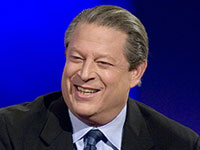
AL GORE - National Anarchist? New Right-ist?

Interview with Al Gore on "Enough Rope"


In his recent book 'Collapse', the author Jared Diamond asked the question: "Why do societies destroy the environment around them when they know their actions will ultimately destroy them too?" An example he gives is of the people of Easter Island, who chopped down their last tree on the way to their own extinction. According to former US Vice-President, Al Gore, we might be doing exactly the same thing with global warming.

ANDREW DENTON: Please welcome Al Gore.

ANDREW DENTON: Good to have you here.

AL GORE: Thank you. Thank you.

ANDREW DENTON: Welcome to Australia. A country I know you visited before, scuba diving on the Barrier Reef?

AL GORE: I have been diving on the reef. It's one of the many spectacular glories of this country. It really is a great place to visit.

ANDREW DENTON: You have been passionately pursuing global warming for 30 years. What is it about this issue that makes you so passionate?

AL GORE: I first became aware of it as a college student, when I had a professor who was the first person, first scientist to measure CO2 in the earth's atmosphere. I felt as if I had a ringside seat at the beginning of a really historic new discovery. And some years after that, when I was first elected to the US Congress, I helped organise the first Congressional hearings, had my professor as the lead witness and I encountered for the first time this incredible resistance to an inconvenient truth, which I later used as the title for the movie and the book, because people are resistant, particularly some of the business interests that have pollution, are resistant to seeing the reality of this. And the more I've tried to tell this story, the more passionately I've become involved in connecting the dots and making the picture as vividly clear as I can.

ANDREW DENTON: Often people who become passionate about a cause, there's a personal stimulus. In your case, it was a near fatal accident for your youngest boy, Al, when he was six. That was 17 years ago. And that caused you to rethink your priorities in your life. How do you make this personal for other people?

AL GORE: Well, that's a challenge. In my own case, I changed both my personal and professional priorities. And put my family first and in lots of ways, in every way, but then in my professional life, I put this climate crisis at the top of the list. I asked myself often the question you have asked me, how do you make it personal for others? At one point in the movie, I ask people to imagine what it would be like if our children's generation decades from now looked back and asked — "Why didn't our parents do something when they could?" And to hear that question now and to realise that the answer must come not with promises but with actions, and I try to connect the story told by the scientific community about the real-world consequences to people in every country. For example, here in Australia, they have long predicted that one consequence of global warming is increasing shortages in the supply of drinking water. And here in Sydney, in Brisbane, in Perth, and other places, you've been seeing that come true. They've predicted more Category Five cyclones. You had two of them this year here in Australia and a Category Four as well. To me, this is so compelling. I think it's the challenge of our lifetimes, and our lifetimes represent the period when the human species will make fateful decisions that will determine the future of human civilisation.

ANDREW DENTON: Yet despite the enormity of what you have just suggested, there are global warming sceptics, people disinterested or not interested in hearing what you have to say. When you're at a dinner party and a global warming sceptic expresses doubt, what do you say to them? What's the thing you zing them between the eyes with to stop them in their tracks?

AL GORE: Well, I had a dinner party in Amsterdam not long ago, and I was at a dinner party, and there were about 12 people at my table, and sceptics spoke up and I said, well, you know, there are some 15 per cent of the people who think that the Apollo landing on the moon was staged in a movie lot in Arizona, and I promise you, this young man said "Well, as a matter of fact…" So I realised I had to come up with another zinger for this young guy.

ANDREW DENTON: It was, though, wasn't it?

AL GORE: (Laughs) Shhh!

ANDREW DENTON: Sorry!

AL GORE: (Laughs)

ANDREW DENTON: That Nixon was up to no good!

AL GORE: Yeah!

ANDREW DENTON: I want to show some of the promotion for 'An Inconvenient Truth'. For those who haven't seen it, it's a very powerful film. FOOTAGE PLAYS: If this were to go, sea level worldwide would go up 20 feet. This is what would happen in Florida. Around Shanghai, home to 40 million people. The area round Calcutta, 60 million. Here's Manhattan, the World Trade Centre memorial would be underwater. Think of the impact of a couple of hundred thousand refugees and then imagine 100 million.

ANDREW DENTON: Now, one of the criticisms you've received for this film is that you have used the worst case scenario, when predictions are not absolute and even the moderate scenarios are pretty scary. What the risk, in having done that, of paralysing people with a sense of helplessness in the face of these events?

AL GORE: There are two questions in one as I hear them. First of all, this is not the worst case. The worst case, you don't want to hear! I think I'm right down the middle and in fact, the scientific community has validated the science in this film, and, for example, the six metre, six to seven metre sea level rise - that would come if Greenland broke up and slipped into the sea. It would come if west Antarctica, the portion that's propped up against the tops of islands with the warmer sea coming underneath it, if it went. If both went, it would be 12 to 14 metres. On Greenland, this past year, there were 32 glacial earthquakes between four point six and five point one on the Richter scale. That may sound like gobbledygook but, you know, a five on the Richter scale for an earthquake is enormous. And there were 32 of them this year on Greenland. That's double the number in '99. In '99 the number was double the number in '93. So that is evidence that what is almost certainly happening, there is a radical destabilising of that big mound of ice. So this is a realistic picture of what could happen if we don't act. Now, as to the paralysing effect of seeing these consequences - that's a real danger. And there are people who go - as I say in the movie - from denial to despair without pausing on the intermediate step and what denial and despair have in common is they both let you off the hook. You don't have to do anything. And actually the mature approach is, that all of us have to take, we have to find our way to it, is to act to solve this. And we can solve it. Despair is completely unjustified.

ANDREW DENTON: I don't wish to dip back into the well of despair but if you're down the middle with this movie, what is the worst-case scenario?

AL GORE: Well, the worst case scenario is that if we did not act fairly quickly, within these next 10 years, make a good start of it, that we would cross a tipping point beyond which it would be impossible to retrieve the favourable climate balance that has led to the development of human civilisation. Such a tipping point would be the melting of the north polar ice cap. If we allowed it to melt by continuing to turn up the thermostat with all of this global warming pollution, then it wouldn't come back at least for millions of years, and the conditions that we have known as a species would disappear.

ANDREW DENTON: I will ask you a bit later in the interview about the things we can do to combat this, but first of all let's look at some attitudes that confront what you're suggesting. A columnist in it country wrote earlier this year that even if climate change is man made, there is little Australia could do that would make any difference that we could measure, because our emissions would be dwarfed by China's and India's. As this is a global problem with no definable boundaries, how do you get the international community, that can't seem to agree on anything, to agree to action on this?

AL GORE: Since the end of World War II there has been the same basic architecture for every international treaty. The wealthier countries that have the wherewithal to go first have agreed to take the first steps and then after we find the pathway and chart the course, then the poorer nations, where per capita income is just a fraction of what it is in Australia and the United States, they then join in the work. And the Kyoto treaty, the first of the treaties to come on the climate crisis, is based on that same model. And if the wealthiest countries, including Australia and the United States, the two hold-outs, refuse to act, then there is little chance that China and India will. If, on the other hand, we do act, then that creates the conditions where these developing nations have to act. Right now, Australia and the United States are the 'Bonnie and Clyde' of the global community on the climate crisis. If Bonnie goes straight and reforms, then Clyde is out there isolated and would feel a lot of pressure to change. If Australia changed its policy, it would put enormous pressure on the US to change.

ANDREW DENTON: Seriously?

AL GORE: Seriously.

ANDREW DENTON: Okay. This is - speaking of the leadership of this country, our Prime Minister has said "I broadly accept the science of global warming but I disagree with the most severe scenarios." This is what he said yesterday about Kyoto and why Australia isn't signed up to it.

(FOOTAGE PLAYS)JOHN HOWARD: If we signed it, we would destroy a lot of Australian industry and we would send Australian jobs to countries like China and Indonesia and India.(FOOTAGE ENDS)

ANDREW DENTON: That's a commonly heard point, that to somehow or other cut emissions will destroy the economy. Is it possible to cut emissions and not destroy the economy?

AL GORE: Of course. And there's an argument that's always made often by industries that have a lot of pollution, when they say "We can't cut back on the pollution without hurting the job picture or the economy." And in almost every case, when pollution controls have been imposed, we find out that they've been crying wolf, and that the adaptation to a more efficient approach actually ends up helping the business and industry in question. There will be some companies that have behaved irresponsibly in dumping prodigious quantities of pollution for which the change will be very inconvenient, but for our economy as a whole, and for most industries, it will actually be beneficial. In the United States, to use one example, our automobile companies, including GM and Ford, have argued for years that if we impose restrictions on the pollution our cars emit, it will cause them to lose their markets and lose jobs. And they got what they lobbied for. The lowest standards. And now they're approaching bankruptcy, because the consumers want to buy more efficient cars. And they're buying them from Japan, and Europe, and so the old saying, be careful what you pray for, should apply, be careful what you lobby for. If you get it, it can be a form of protectionism against facing reality, and reality has a way of intruding.

ANDREW DENTON: I know the Prime Minister, you consider him a friend. You spoke to him earlier today. What did you talk about?

AL GORE: I would prefer to keep the conversation private, because it was just one-on-one.

ANDREW DENTON: Can you mime it?

AL GORE: (Laughs) That's a great idea! I like him as a friend, and it's no secret that he and I disagree on this issue, but I believe him to be a person with an open mind, an intellectual curiosity.

ANDREW DENTON: Will he see your film?

AL GORE: I hope so. He said publicly he might see it, so I hope that he will. And it takes courage to change. You know, we all dig ourselves into positions from time to time, and then defend them as a fortress, as we would a fortress, and the best leaders are ones that know when to change, and when to move into the future. I'm hopeful that he will. I do actually think it would have an enormous influence on the US posture and that in turn would be the turning point in the world's ability to solve this crisis.

ANDREW DENTON: Let me put an alternative view to you. Last year the English House of Lords did an economic inquiry into climate change, in which they suggested maybe that global warming will have beneficial consequences, such as longer growing seasons. Is it possible that you're wrong?

AL GORE: Well, no. That question has been studied, and it's quite true that there will be some temporary consequences that you can interpret in some countries as beneficial, yes. But the negative consequences far outweigh them. And the instability is continuous. Because what we're doing is forcing a radical reorganisation of the entire ecological system of the planet. Today, we're putting 70 million tonnes of global warming pollution into the Earth's atmosphere. And it's just arrogant on our part to believe that we can do that with impunity. That we can so utterly transform the relationship between the earth and the sun by blocking it with this blanket of global warming pollution that traps so much more of the sun's heat into the planet's ecological sphere with impunity. We're not immune to it.

ANDREW DENTON: That's the zinger you should've used in Amsterdam!

AL GORE: Perhaps, I know. That poor guy is still out there looking for the movie lot in Arizona! To put it another way, if you have a child who has a fever, and the fever persists, and it steadily gets higher, you go to the doctor. And you say "Please, let's check this out. What's the problem here?" Because it could be something bad. Well, the planet has a fever. And one or two degrees matters. Two or three or four or five matter even more. And it will continue to get higher until we stop dumping all this pollution into the earth's atmosphere. It is extremely damaging.

ANDREW DENTON: Let's talk about what can be done about it and to do that, let's go back a bit. The 2000 election, sorry to bring it up, this is something that maybe some Australians haven't seen. This is an appearance you did on 'Saturday Night Live' a few years ago where you visited the set of the 'West Wing'.

(FOOTAGE PLAYS)AL GORE: Would you mind if I...

JED BARTLETT: Oh sure, be my guest.

AL GORE: Hmmm...

JED BARTLETT: I guess while you were Vice-President you never actually got to sit in there?

AL GORE: Sorry?

JED BARTLETT: I was just - I guess you never actually sat in the President's chair?

AL GORE: No... No, I did not.(FOOTAGE ENDS)

ANDREW DENTON: I know they had to prise you from the set of the 'West Wing' with several security guards. There has been a lot of speculation about your intentions, even if this movie is some move back into politics. Under what circumstances would you stand for the presidency again?

AL GORE: I did go back on 'Saturday Night Live', just a few months ago, and they began the show with what they called a 'cold opener', with the announcer talking about the speculation that there may be alternate universes, and that some physicists believe that in parallel worlds, other events take place, so-and-so won the American Idol instead of ... and then they start with "Ladies and gentlemen, a message from the President of the United States." And it's me! And I'm saying, you know, gas prices, you would say petrol prices are so cheap now, it's... but anyway.

ANDREW DENTON: Let it go!

AL GORE: Let it go! (Laughs) It's hard!

ANDREW DENTON: I know! I have a therapist, I can help you.

AL GORE: Oh thanks, thanks! I don't intend to be a candidate for President again. I ran twice for President. I ran twice for Vice-President. Been there and done that, as the saying goes. It's true that I haven't entirely ruled out thinking about politics at some point in the future, but that's just an internal shifting of gears, and really, the truth is, I find the political process somewhat toxic at this point. I find I have less patience for some of the tomfoolery that's necessary in politics, and I have found other ways to serve, and I'm enjoying them. And I am involved in a campaign but it's for a cause, not a candidacy.

ANDREW DENTON: And it's the matter of effecting change, that's what you're engaged in. I'd like to hypothetically, let's assume something got you back into the presidency. I want to know how it actually works. I'm not doing it to be cruel.

AL GORE: You've done it several times!

ANDREW DENTON: My work is done! Let's assume you got back into the presidency. How easy is it to effect change? When you got Kyoto up before the international community, when you went back to America, of the 100 senators you approached to support it, only one came across. What did that tell you about your country?

AL GORE: Well, it told me that there was Category Five denial where global warming is concerned. I think that's changed somewhat now.

ANDREW DENTON: Would you get more today if you...

AL GORE: Yes.

ANDREW DENTON: How many do you think you would get?

AL GORE: Hard to say. But almost half of the Senate have voted for a resolution now that is similar to the Kyoto approach. And I do think that we're getting close to a critical mass of support for major bold action. I continued to advocate bold changes, but ran into that brick wall of resistance, and one of the lessons I learned was the need to go to the grassroots level. I don't know if you have that phrase here.

ANDREW DENTON: Yes, we do.

AL GORE: And to go to people one by one, community by community, and engage in a fairly massive and sustained effort to try to change the minds of people about this crisis.

ANDREW DENTON: And to do that, you have some significant opposition. I will show a bit of an ad now from the 'Competitive Enterprises Institute', part funded by Exxon. This is what you might call the anti-Gore.

(FOOTAGE PLAYS)COMMERCIAL VOICE OVER: Global warming alarmists claim the glaciers are melting because of carbon dioxide from the fuel we use. But we depend on those fuels, to grow our food, move our children, light up our lives. And as for carbon dioxide - it isn't smog or smoke - it's what we breathe out and plants breathe in. Carbon dioxide. They call it pollution. We call it life.(FOOTAGE ENDS)

AL GORE: I rest my case!

ANDREW DENTON: The stated aim of the Competitive Enterprises Institute is to create confusion, uncertainty about global science - and global warming science. A Time magazine poll of your country earlier this year stated that 65 per cent of Americans are still uncertain about global warming, which means that they're being effective. How do you combat that?

AL GORE: I don't think that is an accurate reading of where America is right now. I think that a lot of minds have been changed, and I think there is a level of urgency and a degree of certainty about that that's somewhat new and encouraging. A lot of business leaders who used to oppose Kyoto have now endorsed it. Arnold Schwarzenegger and California, of which he is governor, just last week passed binding reductions in carbon dioxide, a very bold measure, the Democratic legislature joined with him. Arnold Schwarzenegger went to see my movie in June and he said "I'm going to get rid of my Hummer." And he said some kind things about the movie and came to one of my book signings. There are now quite a few other state, nine north-eastern states, Pennsylvania, Oregon, state of Washington. In our federal system in the US, sometimes states take the lead, and when enough of them enact their own provisions, business finds it difficult to comply with different sets of standards, and they then say, well, it would be better to have one single national approach. We're in the beginning of that process now. So there is movement.

ANDREW DENTON: What about at the ordinary citizen level, the 'grassroots' level as you put it? In your documentary 30 per cent of greenhouse emissions come from the United States, a super-size-me society which leads the earth by example in gorging on the resources. An example we in Australia follow. Do you detect much willingness among your citizens to downsize the way you live?

AL GORE: Yes, there is a movement. The 30 per cent figure represents the historic contribution. That's the part we're responsible for that's up there now. This year, 22 per cent will come from the US. So there has already been some improvement.

ANDREW DENTON: That's Arnold's Humvee!

AL GORE: That's right. It was a big drop there! (Laughs) And there is now a growing movement toward trying to save on energy bills. The uncertainty in oil prices, Persian Gulf instability, the price of gasoline or petrol as you call it has really hurt the sale of these big SUVs, and promoted the sale of hybrids. So there is such a movement. And when enough individuals make changes in their own lives, it does improve the odds that we'll reach a political critical mass, and then we'll see the policy changes.

ANDREW DENTON: Let's talk about what individuals can do. You lead a carbon neutral life. What is that, how do you achieve it?

AL GORE: You reduce as much as you can by such things as using the new efficient light bulbs, and driving a hybrid instead of a regular car. I'm putting solar panels on the roof of my house, but even with all of that, I still am responsible for a lot of CO2. I flew here to Australia.

ANDREW DENTON: People point this out. You fly a lot of miles.

AL GORE: Absolutely.

ANDREW DENTON: How do you reduce that?

AL GORE: All honour and glory to Qantas, by the way. I had a very comfortable flight over. But for the CO2, that was represented by my portion of that flight, I go into this emerging marketplace for offsets, and purchase verified, validated reductions in CO2 by an amount that more than compensates for the quantities that I'm responsible for. There is a web site that accompanies the movie and the book, climatecrisis.net, that has a carbon calculator that individuals can use to calculate exactly what the magnitude of CO2 that you're responsible for in your own lives - how to reduce, how to find the offsets - if you desire to become a carbon neutral. You could make this show carbon neutral.

ANDREW DENTON: Really?

AL GORE: If you had somebody who was assigned to pay attention to that, you would find a lot of things that would be good changes anyway and then you could find offsets that you could use to get publicity for the show - your audience is so huge now you don't need that...

ANDREW DENTON: Careful. You've already done Qantas, you don't have to do me, it's alright! It's admirable and important what you're saying about how individuals can change their lives and should address change in their lives. But isn't what individuals can do in terms of saving energy in houses a drop in the ocean compared to the people who are the real cause of the problem? In your documentary and in your book, there is no real mention of big companies such as Exxon, who are responsible for something like 20 billion tonnes of world's carbon emissions every year - a sixth of the world's global economy is spent in harvesting oil. What haven't you turned your attention to them, the elephant in the room?

AL GORE: I beg to differ. I have. I don't - I try to avoid demonising specific villains, because really, we are all a part of this problem, and CO2 - the ad that you showed is kind of an obscene version of corporate lobbying, but CO2 is actually the exhaling breath of industrial civilisation, and changing that requires accepting responsibility by these large polluters, yes, I agree with that, but demonising individual companies, I think, diverts from the larger challenge that has to be addressed. I won't shrink from it. Let's talk about Exxon Mobil. What they're doing is absolutely immoral. How they live with themselves in financing intentional lies designed to confuse the public for the purpose of preventing the formation of a public consensus on saving the future of civilisation - I mean, I don't know how they live with that. And I've researched why it is that people no longer think any kind of boycott is - you know, is a viable approach to a company like that. I wish - if it was viable, I think there should be one. I think what they've done is just unforgivable.

ANDREW DENTON: Rather than demonising, perhaps illuminating. If we're talking about real change, if we're talking about a planetary emergency, then we're talking about radical change from the top up. Let's look at how the American political system works. At this day, no-one gets into the Oval Office effectively without the support of these big companies. You and President Clinton had 28 oil and power companies support you. George Bush had 20 million dollars put towards his campaign. Your inauguration was part paid for by an oil company. How do we change the way that system works so that the leaders of our nations are not beholden to these companies?

AL GORE: I think that leaves a false impression of what the reality is. It's true that in the American system, it's common for both parties to accept political action committee contributions but if you look at the reality of the example you use, it's like 20 to 1 on the side of the other party to what the Clinton/Gore campaign received.

ANDREW DENTON: Sure. I'm not trying to get party political but they're integrally involved in the political process?

AL GORE: They are and there is a valid point in what you're saying. I've long advocated complete public financing, taxpayer financing of all federal elections in the United States. I took that position when I first went to Congress in 1976. I reaffirmed it for my campaign for President for 2000. I think the entire conversation of democracy in the United States has suffered greatly because of the inappropriate use of corporate money in politics. But I think it's a symptom of a deeper problem. A problem that's probably worse in the US than it is in Australia. But the way we communicate among ourselves about the great issues of the day. More than 40 years ago, television supplanted the printing press as the source of information for the majority and its dominance has grown to the point that in my country, the average American watches television four hours and 39 minutes per day, and that's 75 per cent of the discretionary time. Unappreciated is the fact that this shift has taken us back to a one-way form of communication, where the information comes from a very few sources, and most people watch television and don't - they can talk back to it if they like but the message is not received, and in that kind of environment, it becomes much easier for special interests with a lot of wealth to dominate some of the messaging that shapes attitudes on issues.

ANDREW DENTON: How do we break that? How do we break that nexus between corporate interests and the way political decisions are made?

AL GORE: Well, I think that focusing on the role of money in politics is part of it. But I think that it's really addressing one of the symptoms rather than the cure. I think that the larger challenge is to democratise the dominant medium, and fortunately, there are now new affordable digital video cameras and laptop editing systems, and young people particularly are learning how to use them. I have started a new television network called 'Current TV', and it's on cable and satellite in 30 million homes in the US, and you can get a training course. We give a free training course to anybody in the world on how to make television. Then they stream the TV to us on the Internet, we post it, and let people vote on what they think the most compelling material is. Now, 30 per cent of our programming is made by the viewers. And if individuals in a nation or in a society are empowered to take part in the conversation, the key is having a meritocracy of ideas so that the people who are part of the conversation themselves decide which of the contributions from all these individuals merit more attention rather than less.

ANDREW DENTON: You know how it works, which is what gets back to Exxon spending money to spread disinformation, the person with the most money is able to put out the most messages and the most skilful messages and they win.

AL GORE: Exactly right. That is the way it works.

ANDREW DENTON: Tear it down, Al, come on!

AL GORE: I'm trying. I'm trying.

ANDREW DENTON: This is what I'm waiting to hear. How?

AL GORE: That's the way it works now.

ANDREW DENTON: Yeah, but how do you tear it down?

AL GORE: I'm trying to tell you. You build a bridge between the...

ANDREW DENTON: I need a zinger, Al!

AL GORE: (Laughs) You see, this is part of the problem, though, you see. It's part of the problem.

ANDREW DENTON: I need an intelligent zinger.

AL GORE: ENOUGH ROPE is the place where you can go beyond zingers, am I right about that? We don't need to just focus on these zingers.

ANDREW DENTON: Yeah.

AL GORE: Please!

ANDREW DENTON: Okay.

AL GORE: All right.

ANDREW DENTON: You got 90 minutes!

AL GORE: (Laughs) That's truly ENOUGH ROPE! But seriously... The Internet allows individuals to get into contact with this incredible universe of knowledge out there, and it allows individuals to take part in the conversation. It has been that individuals find like-minded groups, and that's not entirely bad, but the Internet has not become a main public forum. With television, it is possible for individuals to contribute short-form, non-fiction essays, if you will - here's what I see in my world. Make it creative. The essays attracted an audience depending upon the excellence of the prose, the style of the writing as well as the quality of the ideas and in that same way, these televised expressions have to be compelling and attract their own audience, and as they do, what it can happen is the television medium can be the forum that it was intended to be so that we can once again have a conversation of democracy that is not dominated by Exxon Mobil financing these insipid ads for the virtues of carbon dioxide, but rather, individuals can make their own case...

ANDREW DENTON: We could discuss this a lot further, the whole problem with the profit principle and how that drives markets, but I know you have to go. I want to finish up with the fact this is the fifth anniversary of September 11. And it seems as though the world's attention is forever being wrenched back to the war on terror. How optimistic are you that we can rise above our differences to actually address a planetary emergency?

AL GORE: I don't think it should be posed as an either/or choice. The threat of terror and terrorism is real. All too real. And we must redouble our resolve to protect our citizens against terrorists, and I think we can do so. But we are capable of walking and chewing gum simultaneously. And as we continue to be diligent against the threats of terror, surely we are capable of simultaneously addressing by far the most serious crisis civilisation has ever faced. In fact, if we move beyond our dependence on oil and coal and move beyond this pattern of shipping all this money to the Middle East and the Persian Gulf - that's actually the source of most of the financing that's siphoned off in various ways to feed many of these terrorist organisations. That's not a good pattern. We need to change every part of that. And as we do, we will also gain forward momentum, gain moral authority, gain vision, deprive the terrorists of some of their financing, and find that it's easier to address the other challenges that we have to address, including terrorism.

ANDREW DENTON: And what gives you cause for optimism?

AL GORE: I know one thing about the political system in my country, in yours, and worldwide - that some of the pessimists don't know. It shares a feature in common with the climate system. It can seem to move very slowly, but when we aren't noticing it, it can cross a tipping point and then shift into an entirely different gear and move with incredible speed. We have done that in our democracies in the past. We are close to doing that in reaction to the climate crisis. We will cross that tipping point when enough people internalise the truth of our situation. We have to disenthrall ourselves from the propaganda, from the advertising, from the falsehoods, from the illusions, and we have to see the reality of this new relationship we have to the earth. We have quadrupled population in less than 100 years. We have thousands of times more powerful technologies. We're like the bull in the china shop, except that we have the capacity to become aware of what we're doing. When enough people become aware of it, understand it, and then decide that we owe it to our children to leave them a planet that is not degraded, and hostile to the human species, then we will find ways to solve this. I know that we will.

ANDREW DENTON: Al Gore, I hope you're right. Thank you very much.

AL GORE: Thank you.

To find out more about 'An Inconvenient Truth', visit the Climate Crisis website.

The 'carbon calculator' that Al Gore mentioned in the interview is also available at the Climate Crisis website.

http://www.abc.net.au/tv/enoughrope/transcripts/s1734175.htm

Friday, September 08, 2006

THE RADICALISATION OF THE MIDDLE CLASSES

By Welf Herfurth*

'...National Socialism is not merely a political and economic upheaval but a social revolution as well. To a very large extent it has brought the lower middle class into power. To be sure, one finds quite a few aristocrats and intellectuals in the Nazi regime. Furthermore, there are plenty of Nazis sprung from peasant or worker stock, some of whom, like the Weimar Gauleiter, would rise in any society. Yet the lower middle class seems to be inordinately in evidence. One does not notice this so much in Berlin, because the ablest elements in the Party tend to gravitate to the seat of power. In the provinces the Spiessbürgertum comes much more to the front.'

- Lothrop Stoddard, 'Into the Darkness' (1940)


Recently, the Sydney Forum hosted Professor Andrew Fraser, who gave an illuminating speech on, among other things, non-white immigration into Australia. He took the position that the 'Anglo-European' Australians (as he calls them) ought to resist the immigrant tide. But, he asked, how are the masses, or a significant proportion of them, to be mobilised into taking action? He declared that he did not, at present, have the answer. He did suggest, however, that as a first step nationalists should be aiming at a movement, at building a groundswell of support, before forming a political party; nationalism, he said, should be extra-parliamentary.

Another point that emerged, during discussions with other members attending the Forum (after the presentations by the guest speakers were over) was that a clear difference exists between radical and reactionary nationalists. A perfect example of the latter is Pauline Hanson, who, it could be argued, was a reactionary as well as an agrarian socialist. (One can be a socialist - ie, demand a redistribution of wealth - and be, at the same time, reactionary).Reactionary nationalists want to turn the clock back to an idealised Australia (or France or Germany) of the recent past. In the Australian case, they celebrate the parochial folk culture of Australia - ie, use Ned Kelly and other Australian folk figures in their iconography.

The radical nationalists, on the other hand, want a progressive movement forward - more than that, a complete break from the past and its traditions. We can classify Mussolini, Robert Mugabe, Che Guevera, Mao Tse Tung, and Hugo Chavez as men who are nationalists, radicals and socialists.

(Perhaps a clearer illustration of the difference that exists between a radical and a non-radical lies in the split in the mainstream Left in the West in the late sixties and early sixties. One side of the Left - the reformist - advocated working within the system and making changes within the context of liberal parliamentary democracy. Their tendency, even if they were communist, was to join the Democrats in the USA or the Labor Party in Australia and attempt to steer the ideology of those organisations towards communism.

On the other hand, the more radical Left advocated extra-parliamentary 'direct action' - the most spectacular examples of which were urban guerilla terrorism. Examples of urban guerilla radical groups are Baader-Meinhof in Germany, the Weathermen in the United States, the Red Brigades in Italy, and the Tupamaros in Uruguay).

One can see, from this example that a world of difference exists between the radicals of the Left and the reformists and moderates. Even if the moderates, in this case, sympathies with Trotsky and Mao - both radicals - they are still moderate by dint of their actions.

It occurred to me, after the Forum and the subsequent discussions, that the history and ideas of the Left, particularly the New Left, have a great deal of relevance to nationalism today in Australia and the rest of the Western world. Throughout this article I will be using standard terms most often found in Marxism - 'Left', 'Right', 'working-class', 'middle-class', 'bourgeois', etc - but without any evaluative tone. That is, I will not be using the word 'middle-class' as a term of opprobrium, as the communists and some neo-fascist intellectuals, such as Evola, do. These words shall be used as descriptive tools only.

A relevant text for the purposes of this article is Georges Sorel's Reflections on Violence (1908), which tackles some of the problems raised by Marxism - in particular, the failure of the working-classes to behave as the Marxist theory predicted. One of his conclusions was that attempts to bring about class consciousness through pure theory were doomed to fail. What mattered was an enabling 'myth', an idea which would induce class-consciousness among the proletariat, force them to undertake direct action against capitalism, and bring about revolution.

Sorel's solution - a syndicalist one - was the general strike, which would bring about all the conditions needed for the formation of class-consciousness, class-war, etc.

The advantage of Sorel's approach was its simplicity and directness. Modern Leftist groups try and bring about revolution by handing out issues of the Green Left Weekly on university campuses - when little to no proletarians are in attendance at those universities, and, in any case, have little interest in a refried Leninism. The Socialist Alliance also gets involved in campaigns to end sanctions against Iran, or get the Australian government to take Hezbollah off its list of terrorist groups - which is all very worthy, but has little to do with socialism, and again, fails to get the attention of the Australian working-classes. What the Australian communists need is a catalyst, a trigger which, like Sorel's general strike, brings about the conditions of change in one stroke.

Like the communists, the Australian nationalists are looking for a catalyst. They have in mind a revolution
- a racial revolution - in which white Australians will suddenly develop racial consciousness and sweep all the non-white immigrants away. Cronulla, for a time, seemed to be such a trigger event. Other racialists take a more gradualist approach: the white masses will develop race-consciousness, and then embark on a racial revolution, but only after non-white immigration gets to the point that it becomes unbearable. This is similar to the Marxist theory - that capitalist societies will inevitably become communist ones because of the progressive 'immiseration' of the working-classes, which continually lowers their living standards.

There are a number of problems with the Australian (and in general, white nationalist) approach. Without a doubt, endless non-white immigration has seen to a progressive deterioration in the quality of life in Western societies, and even mainstream politicians and media commentators (in, for instance, Britain, where the effects of immigration in the past ten years have been profound) are beginning to remark on that fact, or at least discuss it. But, by itself, immigration is not sufficient to bring about the revolution the white nationalists (or at least the more radical of them) are seeking. If one has a distaste for living and working among non-white people, one can simply move to a more white area - or a more white country. It may well be that the immigration of Sudanese asylum-seekers will expand to the point where whites have nowhere left to live; the pinch on available land and resources will be such that whites are forced to take action. But that, at present, is in the far future.

I myself believe, too, that the predictions of the demographers, who say that the British will be a minority in their own country by 2050, are too apocalyptic. Yes, immigration will continue to rise; but whites are not at the point of being bred out. (Even Bill White has written a number of articles arguing for this point). Which is not to say that immigration is not a pressing issue: it is. But it is not pressing enough for the white masses to rise up and do anything about it.

In order to get any group to take action - and here my analysis shows a trace of Marxism - their economic interests have to be affected. Economics also has a history of remarkable success in mobilising the disparate members of an ethnic group towards the same objective. Marx believed that capitalism, by affecting the working-classes economically, would be sufficient to make the proletariat realise that they share a common interest. Likewise, the economic effects of capitalism can unify members of an ethnic group. A case in point is the coup against the ethnic-Indian dominated Chaudry government in Fiji in 2000. George Speight and a number of other black Fijians stormed the parliament and held members of the government hostage for nearly two months, and Chaudry's government was overthrown in a military coup. What was the motive behind the coup? Simply that the economic interests of black Fijians were being affected. The Fijian constitution enforces black Fijian ownership of 83 per cent of land; Chaudry's government, it was felt, would introduce land reform - with the inevitable result that the hard-working and clannish ethnic Indians would buy up all the land.

The Speight coup is something white nationalists can only dream about. Speight managed to mobilise a large segment of his ethnic group behind him and overthrow the existing government (dominated by members of a foreign ethnic group) with ease. The key to his success was that his ethnic group saw that their economic interests would be endangered by a free-market economic system, in which Indians could buy all the land they wanted from Fijians; and so they gave him support.

I am not suggesting that nationalists here in Australia, or Europe or America, follow Speight's methods. I am using the Speight case to suggest that a serious racialist political attitude comes from socialism, or rather, a determination to protect the economic interests of one's racial or ethnic group against competition from outsiders. At the Sydney Forum, nationalist activists decried the fact that it is hard, these days, to mobilise 'decent people' to take up arms for the movement; that it was difficult to get women involved. Instead of reaching a wide cross-section of society, modern nationalism in the West seems to reach only a small proportion. (In an article by the New Right Australia New Zealand, titled ‘Freaks in the Movement”, it has been argued that that small proportion is primarily made up of the underclass - the working poor and the welfare class). The reason why is that nationalism is not appealing to the economic self-interest.

Nothing, in my experience, motivates middle-class Australian women more than the threat of immigration from the Sub-Continent - of Pakistanis and Indians and competing with them for the same jobs and the same contracts in I.T., law, medicine, finance, small business, engineering, science. We need plenty of members of that demographic - white-middle class women (and men) in the movement, but we are not getting them because we are not addressing their economic concerns.

The white Australian middle-classes dislike Sudanese asylum-seekers, and Vietnamese and Lebanese on welfare, but cannot be expected to be passionate about these issues. Why? Because the middle-classes are not welfare recipients, and are not competing against those migrants for state aid! But they are competing, in the field of business, against immigrants from the Sub-Continent.

(Perhaps one of the defects of nationalism in Europe is that it concentrates too much on immigrants who hail from the Middle East and North Africa. Arab, Kurdish, Turkish and African immigrants want to immigrate to Europe in order to get jobs in the low-wage service sector or to go on welfare. The economic interests of the middle-classes are thereby unaffected, even though these immigrants may become a social problem - ie, they go out and commit crimes. To my knowledge, the North African and Middle Eastern immigrants in France are confined to huge urban ghettoes and only infrequently come into contact with the white French. So they do not present a direct economic threat, either to the French working- or middle-classes).

This article does not aim at giving solutions to all the problems which afflict the nationalist movement; it, rather, aims at giving a clear statement of the problem. We have to clearly outline, among ourselves, what it is that we want. Once we have determined our goal, we can canvas the various means of reaching it.

The Marxists have a number of means of reaching their goal: some favour infiltrating liberal democratic parties; others, trade unionism; others, 'direct action'; others, terrorism; and so on. But, unlike the Marxists, we nationalists are not exactly sure of our goal.

What is it then? What is it that we want? I think we can summaries it as follows. We want a nationalism which is in keeping with historic Western and European nationalism of the past and present - European fascism, post-war neo-fascism and the Nouvelle Droite and thinkers in that circle (such as Guillaume Faye); a nationalism which is in tune with modern economic, social and geopolitical realities; a nationalism which is radical, not reactionary; a nationalism which has its base in the middle-classes; a nationalism which is socialist and left-wing.

The last of these needs some explanation. Socialism means a number of things: it means the redistribution of wealth through taxes, transfers and nationalisations, to a favoured sectional interest (in the case of Marxism, the working-class; in the case of the nationalism I am proposing, the middle-class). It also means protecting that favoured interest from competition (in the case of Marxism, cheap, imported and usually low-skilled labour) and maintaining the economic position of that interest against changes brought on by the market or by recession. The main threat to the position of the white-collar middle-class today is from non-white migrants, usually from the Sub-Continent (but not restricted to there).

Competition from that source will undercut the wages and living conditions of the white-collar class, and damage the country's national and cultural cohesiveness as a whole. So our socialism would oppose that form of migration, perhaps more vehemently than migration from Sudan or Kurdistan.

Which is not to say that migration from Africa or the Middle East is not a problem - of course it is - but the failure to address middle-class concerns is one of the reasons why nationalism has made so little headway in Australia and, perhaps, in Europe and North America as well. It is only by addressing the bread and butter issues, and the concerns of the class we most need to have on our side - the middle-class - that nationalism will become a mass movement, and then, after a sufficient period of growth, an electoral movement.

Once we have worked out the basics of what we want from nationalism, we can then go on to debate the means by which we will attain our goals. Hugo Chavez, for example, knows exactly what he wants: he wants to redistribute his country's wealth to his electoral base, the Venezuelan poor, in particular, the slum-dwellers of the urban centers like Caracas. He uses a variety of methods to achieve that goal, never confining himself to one, but can only do so with some success because he knows what he wants.

So I am not here, in this article, proposing any means; only ends. Once the nationalists here in Australia and in the Western world know what they want and can state their aims and goals with some clarity, we can proceed.

Otherwise we will be, like in the past decades, barking up the wrong tree and go nowhere.


*Welf Herfurth is a political activist who lives in Sydney / Australia. He was born and raised in Germany and can be contacted on herfurth@iinet.net.au