Tuesday, March 27, 2007

AGAINST PRESS FREEDOM : ERNST ZÜNDEL AND PARLIAMENTARISM

by Welf Herfurth* and Tom Stanwell

As most readers know, the Holocaust revisionist Ernst Zündel was sentenced to five years jail by a German court - after being kidnapped, from America to Canada, held for two years without charge in a Canadian prison (under anti-terrorist legislation) and then deported to Germany, where he was charged with multiple counts of Holocaust denial. It is unknown, at this point, if the court will take into account time served. Predictably, the German media were hostile to Zündel and his defence team, but worried if the severity of the sentence - and the fact that freedom of speech on the Holocaust is illegal in Germany and around 30 states in Europe - would turn the 'Neo-Nazi' Zündel into a martyr.

The intention of this article is to look at the question of freedom of press, and freedom of speech, in nationalist ideology, in relation to cases like Zündel's. The repression of Holocaust revisionists and nationalists in the West is denounced, by nationalist activists, as being a violation of those two freedoms. Liberal democracies claim to be that - liberal - but, at the same time, censure and punish denials of the Holocaust, as well as expressions of racism. The hypocrisy of this position is pointed out by nationalists. While I agree that it is a contradiction, certainly, my argument here is to defend the likes of Zündel on different grounds from the liberal. That is, because our opponents are themselves illiberal, we do not need to become liberals in opposition to them.

I am unwilling to criticise the revisionists - who have suffered for their ideals, in the cause of both truth and nationalism - and their followers. But it must be said that their work suffers from an ideological deficiency, even an emptiness. Zündel, Rudolf, Graf, Faurisson and others write on contemporary political events, with great insight, not the least because of their experiences. But their politics, fundamentally, boils down to the view that once the truth about the Holocaust is revealed, the West, and the rest of the world oppressed by Zionism (or those acting as proxies for Zionism, e.g., the Americans in Iraq and Afghanistan), will be free. It is, in fact, liberalism (as will be explained later). There is a lack of an intellectual, and even an ideological, basis in their writings. Which is ironic, given that the revisionists are accused by Jews as being part of a vast 'Neo-Nazi' underground, a conspiracy to introduce a 'Fourth Reich', and, by the peculiar Jewish logic, of justifying a future slaughter of the Jews by denying a past one. If any of these accusations were true, revisionism would be part of a political movement, and revisionists would be acting with a political intent. But it is the lack of a theoretical basis, leading to political action, which is a source of weakness in Holocaust revisionism, and much of contemporary Western nationalism.

The absence of an ideological center, in Holocaust revisionism and in unreflexive nationalism, means that both become easy prey for other, consistent, intellectually-worked ideologies. That is, because the Holocaust revisionist lacks an ideological center and ideological training, he will take on board the first ideological system that comes along, and spout its values. Hence the adoption of liberal rhetoric among the revisionists and the activists who support them: free speech is concomitant with democracy, we cannot have a liberal society without debate, etc. Just as the uneducated trade unionist will take up Marxist rhetoric and Marxist slogans, the revisionists take up liberalism, and nationalist activists are in perpetual danger of becoming liberals.

In the case of the trade unionist, Marxism does no harm; in the case of the nationalist, liberalism does a great deal of harm. For, in my opinion, liberalism is the source of all the problems which bedevil the nationalist so much: immigration, Zionism, the repression of Holocaust revisionism, bad economic policy and a host of other evils which are the product of, simply put, bad government. It is not that liberal ideology is a direct cause of, say, the repression of Holocaust revisionism; only that the adoption of a liberal political system will invariably lead to negative consequences, such as that repression.

[...]

In this instance, the work of Carl Schmitt is useful, in particular, his book, The crisis of parliamentary democracy (1923). The second chapter in that book - 'The principles of parliamentarism' - outlines the ideology of what Schmitt calls 'parliamentarism'. He expounds the view that parliamentarism is an offshoot of liberalism, which is itself a complete view of the world, a weltanschauung, even a metaphysical system (no matter what its proponents say). Liberalism sees the world as being made up of free and independent individuals. In the economic sphere, these individuals compete with one another in the market, selling their goods and services. The individual who is most successful - that is, who earns the most patronage from the consumer - wins. Even though some individuals lose out in the struggle, overall, the clash of competing interests leads to a greater harmony, a greater equilibrium, a greater balance.

Does liberalism apply in the purely political sphere, outside of the marketplace? The answer is, says Schmitt, is yes. Parliament is itself an instance of this clash of individuals wills which, in the end, leads to equilibrium. But the contest is not a market one: it is a contest of ideas. The essence of political liberalism is free and open discussion of ideas and opinions between free and independent individuals, and the willingness of those individuals to be persuaded. From that debate, the 'truth' emerges - truth emerges from the great debate, the never-ending discussion, that takes place in parliament.

Following the French thinker Guizot, Schmitt lists three characteristics of the parliamentarist system:

(1) that "the powers" are always forced to discuss and thereby seek the truth together; (2) that the openness of the whole of political life places "the powers" under the citizens' control; and (3) that press freedom prompts citizens to seek the truth for themselves and to make it known to "the powers". Parliament is accordingly the place in which particles of reason that are strewn unequally among human beings gather thesemlves and bring public power under control. (Carl Schmitt, The crisis of parliamentary democracy, p.35).

He adds, 'Freedom of speech, freedom of press, freedom of assembly, freedom of discussion, are.. really life-and-death questions for liberalism' (p.36).

The rationale behind the secret ballot is that one's voting choices must remain private - that is, they are the expression of a private, free individual. Again, from conflicting individual interests, conflicting private opinions, a harmony, a balance, emerges. Through voting, the people find truth - or rather, they elect representatives who find truth for them through open debate in parliament. (Schmitt notes - and this is an important point - that democracy does not necessarily depend on the practice of elections. The sum of voters is not the sum of the people).

Liberalism and parliamentarism is the source of the structure of our modern political system. For instance, the concept of the separation of powers, or the division (or balance) of powers, in the representative assemblies, finds its justification in liberalism. That the American legislature, executive and judiciary should be made up of individuals from different parties is seen as good by the liberal media: it represents the division of power, in which no single party or institution wields an absolute total of power. And that the same divisions repeat themselves, not only at the American federal, but at the state level - at the level of the state executive, legislature and judiciary - is praiseworthy. Why? Because the multiplicity of opinions, the clash of opinions in a free and open discussion is taking place at every level.

Parliament becomes a forum for debate, for clashing opinions, for free and open discussion - and for finding the truth. The rules of the game are that every participant in the debate respects one another: that the other participant has the right to speak, and speak freely, because this is the only way that truth can emerge. A participant with a 'totalising' truth - for instance, the Marxist, who believes that truth has already been arrived at in the works of Lenin and Trotsky, and not through debate - is not welcome. Or, if he is to be allowed into the parliament, he must agree to respect the rules.

One can see, from this, how important a free press is. It provides another venue for free and open discussion. As well as that, through publicity, it reveals truth. Free reporting exposes secret government business (or secret corporate business) to the glare of publicity, exposing the truth. Hence the lauding of the work of crusading investigative journalists like Woodward and Bernstein, who exposed to the world the Nixon administration's nefarious doings. The saying that a free press is concomitant to a democracy, to a free and liberal society, has become one of the clichés of our age, if not a dogma, spouted by liberal ideologists and more often by journalists themselves.

We can see that the liberal and parliamentarist doctrine is reflected in the work of the Holocaust revisionists and the activists who fight for them. Holocaust revisionists have a (perhaps naive) view of the value of publicity - that is, the exposure, for all the world to see, of the hoax of the Holocaust shall set the world free. All that would need to be done is for the laws banning Holocaust revisionism in Europe to be repealed, and Europeans would find the truth for themselves. In the calamitous uproar which would follow the revelation of the truth of the Holocaust, the obsessively pro-Zionist, philo-Semitic liberal democratic politicians of Europe, and the West, would be forced to recognise the error of their ways. This view is, in fact, the liberal and parliamentarist view of the value of truth, publicity and the free press.

Likewise, the ultimate justification for Holocaust revisionism - or rather, the right to deny the Holocaust - lies in the liberal doctrine of free speech. If society is made up of free individuals who are to be allowed to express their opinion, in newspaper articles, political demonstrations and in parliamentary debates, then Holocaust revisionists ought to be allowed to do the same. Indeed, the tolerance of Holocaust revisionism is a litmus test for a free society, because many individuals have been conditioned to look at revisionism with revulsion.

So what is wrong with this: what is wrong with using liberal doctrines to justify the practice of Holocaust revisionism? The answer is that liberalism, as a doctrine, is simply false. As Schmitt writes:

Discussion means an exchange of opinion that is governed by the purpose of persuading one's opponent through argument of the truth or justice of something, or allowing oneself to be persuaded of something true or just.... The characteristic of all representative constitutions is that laws arise out of a conflict of opinions (not out of a struggle of interests). To discussion belong shared convictions as premises, the willingness to be persuaded, independence of party ties, freedom from selfish interests. Most people today would regard such disinterestedness as scarcely possible. (Schmitt, Crisis, 'Preface to the second edition (1926)', p.5).

Most of Schmitt's attacks on parliamentarism in this book are in that vein. That is, parliamentarism, or liberalism, does not work the way it should anymore, if it ever did. Parliament is hostage to 'invisible powers', representatives of the unions, big business, the Jewish lobby, and the like - and those representatives are not, for one, willing to be persuaded. The real government business - like the kidnapping, deportation of Ernst Zündel, and even the outcome of his trial - is done behind closed doors.

One can still uphold parliamentarism as the best system, the best available at the present time. But if that is all we have as a justification for a system - that the only justification we have for it is a purely pragmatic one, that we should keep it simply because it continues to work, and work well - then that system is lost, and we can no longer believe in its validity. (Schmitt compares the present loss of belief in parliamentarism to the waning away of the belief in the divine right of kings).

But the implications of a lack of belief in the value of parliamentarism are manifold. For one, the institutions of parliament - freedom and speech and immunity for parliamentary representives, the openness of parliamentary proceedings, the declassification of cabinet minutes after thirty years, the freedom of information act and so on - lose their meaning. And likewise, liberal beliefs, practices and institutions - the separation of powers, the value of balance of conflicting opinions and interests, and all the other legal and constitutional traits of a liberal order (which have been described in Schmitt's book but not been detailed here) - lose their meaning. So the effect of Schmitt's criticisms (and the criticisms of other opponents of liberal parliamentarism, i.e., communist groups) is that the sacred cows of our present system of liberal democracy - free and fair elections, parliament and parliamentary procedures, free press and free speech - lose their sacred qualities.

Many nationalists feel this already, of course. They feel, for instance, that the liberal media in the West is not so liberal - that it is in the service of 'hidden powers'. The Australian public-owned broadcasting TV channel SBS, for instance, failed to mention the Zündel sentencing on the day that it occurred, choosing instead to focus on the death of a minor Vichy-era French official who may or may not have been responsible for sending thousands of French Jews Auschwitz for gassing and cremation. The entire Western media constantly keeps the atrocities of the Germans in WWII (real or alleged) in the public eye, around the clock, and is not even interested in ideological balance. (For instance, the death of an American soldier who worked as a guard at one of Eisenhower's death camps in occupied France, or a Polish communist official who oversaw the ethnic cleansing of millions of Germans, would hardly be remarked upon).

But this applies in other areas of political reporting as well. Take, for instance, the press' uniform acceptance of the Bush administration's contention that Bin Laden and Al Qaeda were responsible for 9/11; or Bush's declaration of 'victory' three weeks into the Iraq war; or that it was Saddam Hussein who had been 'captured hiding' in an abandoned farm house in Tikrit. In each of these cases (and many others), some real investigative reporting, or at least some questioning of the official line, was called for. Had the Americans really conquered Iraq in three weeks? Was the man the Americans claimed to have 'captured' really Saddam Hussein? Did Bin Laden really carry out 9/11? Are the daily communiques from 'Al Qaeda' genuine, or the product of a Western intelligence agency? Perhaps, in each of these cases, the Bush administration could have been exposed to the unpleasant glare of publicity, the truth could have been made known to the masses, a la Woodward and Bernstein. But no. The truth is that the Western media is equally as totalitarian, and supine before State power, as much as the Chinese or North Korean media is. And the same can be said, by extension, for academia, the entertainment industry. All seem to be under the same central control, or at least, subscribing to the same ideology. Even the self-professed alternatives to that mainstream ideology - for instance, Noam Chomsky, or Michael Moore - strenuously deny, or refuse to mention, the existence of a Jewish lobby in the United States which influences the latter's foreign policy in the Middle East (hence, the radical Chomsky is allotted front-page space in the Guardian newspaper).

All of this is well-known to nationalists: our lack of belief in the freedom of press is as pronounced as that of the Marxist's. The question is what attitude we should take. We can demand, along with those who still believe in liberalism, a truly free press, which gives equal space to Robert Faurisson and a publicist for the Jewish lobby on the same op-ed page; or one can give up on the possibility of there ever being a free press altogether.

I myself subscribe to the latter view. If liberalism, and parliamentarism, has no longer any value, then the concept of a free press no longer has value - it is no longer an ideal we should strive towards. On top of that, the notion of a mainstream Western newspaper ever even considering granting op-ed space to the likes of Faurisson is unlikely - it would take a miracle. Or rather, it would take a cataclysmic revolution in which the Jewish lobby would itself cease to exist as a political force (and hence, there would be no need to grant its agitators 'equal time' in the media).

I am a nationalist before I am a liberal - not a nationalist liberal. My own immediate reaction, on seeing yet another nonsensical Holocaust story on the nightly news, is as follows. Under a nationalist government, all journalists should be made to join a national journalist's union. Membership in that union would require that they refrain from peddling their daily dose of multi-racialist, philo-Semitic, German-hating pap; any journalists who refuse to join will lose their jobs. That system, of managing the news, would be not that different from our existing one, except that such a journalist's union (which, contrary to our hypothetical nationalist one, requires journalists to report constantly on the Holocaust, or denounce the Ku Klux Klan, or denounce apartheid, etc.) is invisible; it has no official existence, although it is constantly making itself felt. The rule is that anything that is untrue - and the Holocaust is untrue - and that anything which is destructive to the long-term survival and health of the Western Christian civilisation ought to be suppressed as ruthlessly as any Holocaust revisionism, etc., today is suppressed.

And here we are straying into a grey and murky area. The doctrine that a press should no longer be 'free', that it should serve a political purpose (in our case, a nationalist purpose) - could be anathema to most nationalists. This is because most nationalist and Holocaust revisionist activists are used to being persecuted by the State and its organs. The fact that they receive no help from groups claiming to uphold civil liberties - like Amnesty International, or Human Rights Watch - does not diminish their appetite for liberalism. Indeed, the repression of freedom of speech, in the European countries which ban Holocaust denial, for instance, is held by some nationalist activists to be the manifestation of a new leftist totalitarianism, a new Marxism, which, in the past two decades, has seized power through social democratic and communist parties and hence undermined liberalism and liberal democracy. Many backward-looking Far Right populist parties look nostalgically to the Europe of the 1950s and the 1960s when one could deny the Holocaust with impunity (even in West Germany) and discuss racial and immigration questions openly. So the suggestion that the 'rights' of journalists should be curtailed, that the institution of a 'free press' be attacked, would rankle some nationalists, and understandably so.

But this is, I believe, shows a misunderstanding of the nationalist ideology. Liberalism's view of freedom is negative: it denies the right of government to interfere in the private sphere of individuals, or at least, seeks to limit that interference to the bare minimum. Many nationalists, unfortunately, only desire that negative freedom: that is, all they want is the freedom to vent their animus against non-white immigrants, indigenous Australians, North American Indians, the Jewish lobbyist, and politically-correct Marxists and multiculturalists - and that is all. Their nationalism cannot be said to be a striving for something: for a better world order, for example, a real improvement in the life of the race they belong to. Their position can be characterised as a reactionary liberalism, a backward-looking liberalism.

Other nationalists, however, do want a better world and do have positive ideals. But, it is argued here, in order to achieve those ideals, it must be recognised that they cannot be achieved in a liberal and parliamentarian political order. The reasons for this are apparent once we examine the tenets of liberalism closely. At the ideological level, liberalism upholds the equality of all human beings: that is, all humans are politically equal simply by virtue of their being adult persons. But an ideology which gives a unskilled, illiterate Mexican immigrant to the United States the same value as a literate, skilled American proletarian or bourgeois is really the antithesis of nationalism; it and nationalism cannot co-exist. Likewise, the parliamentarian system, of selecting leaders and representing the people, is the antithesis of nationalism. Certain policies are popular with the people - for instance, a cessation of non-white immigration, or the reintroduction of the death penalty for child rapists and sex murderers - but parties which uphold such policies are consistently voted down, or never receive the votes they need. This is because, in part, of the voting process itself. The secret ballot system forces voters to think of themselves, not as members of a community, but as private individuals with private economic interests - despite the fact that they are voting on matters of public law which pertains to public matters.

The problem is, in part, a procedural, and a legal and constitutional one. It is no good having political ideals if the means of bringing them into reality - parliamentarism - is flawed. The ideals of nationalism - a positive nationalism - are, at bottom, not so complicated. The nationalist, in the last analysis, wants a community with a high standard of living, safe and pleasant cities and towns to live and work, a healthy and uplifting cultural life, a society in which ugliness and squalor are removed, a community where the members feel a sense of belonging with one another and care for one another while at the same time respecting one another's autonomy. These values are not so controversial, and even liberal democratic politicians would agree that they are desirable. The main difference between the nationalist, and the believer in mainstream liberal democracy, is that the latter believes that goals such as civic cleanliness and safety, and an increase in the standard of living, can be achieved alongside, for example, massive non-white immigration and the abolition of the death penalty. Hence the absurd spectacle of the social democratic, left-liberal politician who advocates an increase funding for the arts and better urban planning while, at the same time, advocating policies which increase squalor and ugliness. (In Sydney, Australians are faced with the irony of having the Sydney Opera House - a famous and distinctive Australian cultural monument - located a few metres away from an enclave of homeless heroin addicts. The urban centre of Sydney is itself populated with an enormous number of Asian immigrants who certainly feel no connection, no sense of cultural kinship, with the Western culture which produces the operas and ballets performed at the Opera House, and neither can the abusive, drunken, uneducated Aboriginals who live in nearby suburbs).

Why is this? The answer, in this case, is that the social democrat is a socialist, and a believer in the power of government to improve the standard of living of its citizens - economically, socially, culturally. But, at the same time, he is a liberal: individuals should be allowed to do what they want, so long as they are not breaking the law. Drunken Aboriginals, the homeless heroin addicts, the beggars in our urban centres, non-white immigrants, all have rights - as does the film-maker who glorifies interracial couplings. Child rapists may have broken the law, but even they must be supported, at the taxpayer's expense, for the rest of their lives in jail instead of being executed - for execution would be inhumane. And so it goes. Social democracy, because of its subscription to parliamentarism (the 'democracy' in 'social democracy') , invariably ends up removing government policy of any common sense and decency, and making day to day living, especially in the cities, uglier and harder.

So the answer is: in order to achieve nationalist goals, the existing liberal and parliamentarian order must be overturned. We must stop pretending that we are liberals, no matter how attractive some of its ideals may seem. I myself have been to nationalist conferences which have come under attack from both political authorities and anti-racist activists. Commonly, participants will defend the right of that conference take place in the name of the liberal right of freedom of speech. Such sloganeering has real power, undoubtably. But we nationalists must ask ourselves: are we nationalists undertaking such events in the name of freedom and liberalism, or because we seek to improve the lives of the fellow members of our community, our nation? The question answer itself.

German media commentators often call for the banning of German nationalist organisations like the NPD in the name of 'democracy' (i.e., liberal democracy). They claim that, while the likes of the NPD demand the protection of their rights as a political organisation in the name of liberalism, they are opposed to liberalism. (They would oppose the freedom of Turkish immigrants to live in Germany, for example). So, paradoxically, the German liberal democratic State must be illiberal to be liberal, and ban the German nationalist groups and wipe them out.

Those commentators are right, in one respect: liberalism and nationalism are ultimately incompatible (although nationalism and democracy are not, as Schmitt argues in his book). In the end, one must go. Nationalists cannot, in Germany, for example, agitate against 'democracy' directly - that is forbidden under law. (Probably, 'democracy' could be agitated against in Germany, but that would require a lawyer's knowledge of the German constitution. In any case, the defenders of 'liberal democracy' can always twist a constitution to say whatever they want). But the works of Carl Schmitt, for example, are still legal in countries like Germany which have 'anti-anti-democratic' laws. Liberalism, and parliamentarism, can still be assaulted intellectually, and that is where we must begin.

*Welf Herfurth is a political activist who lives in Sydney / Australia. He was born and raised in Germany. He can be contacted on herfurth@iinet.net.au

Thursday, February 22, 2007

Achieving Nationalism through Discipline

by Tom Stanwell


I. Are we fascist or Nazis?

The enemies of nationalism are accustomed to calling us 'fascist' or 'Nazi' (or 'Neo-fascist' or 'Neo-Nazi'). In the modern sense of the word, 'fascist' has a number of meanings: it is used as a perjorative term by communists to describe anything which is anti-communist and at the same time vaguely authoritarian and militaristic; while, in the everyday sense, it is used to describe something authoritarian, repressive, totalitarian. Similarly, 'Nazi' is used to refer to skinheads, Nutzis, or any creed which is anti-Jewish, anti-communist and racialist; and, in the everday sense, it means someone who is excessively pedantic, harsh, intolerant, authoritarian.

But what really does 'fascism' - if we are to use it as a term to describe certain political movements in Europe which ceased to exist in 1945 - mean? It refers to a definite ideology, a definite political philosophy. A few serious academics - such as Roger Griffin, Stanley Payne and others - have attempted to define it, with varying degrees of success. Certainly, the fascist ideology is a well thought-out political philosophy - as can be seen from the work of Julius Evola, Francis Parker Yockey, Jean-Francois Thiriart and other theorists of post-war fascism. In theory, fascism means the works of these men; in practice, it means certain regimes which existed before the end of the war - National Socialism in Germany; Italian Fascism in Italy; and so on. (It could be argued that the post-war fascist intellectuals had a better theoretical understanding of fascism than the wartime and pre-war practioners).

But whether or not the nationalism in the West today, in the year 2007, could be described as fascist - that is debatable. The word 'nationalism' is shorthand for a good many ideologies: Christian Identity; skinheadism; Neo-Nutzism; the thinking of the Nouvelle Droit intellectuals; National Anarchism; and so on. It can also be used to describe political parties - populist parties such as the FN in France and the BNP in the UK, and the NPD and the DVU in Germany. Most of these ideologies and groupings have a number of things in common: opposition to non-white immigration; revisionist view of WWII and the Holocaust; concern for freedom of speech (particularly in regard to the repression of Holocaust Revisionism, or criticism of immigration and multiculturalism); anti-Zionism... But none of this, alone, is, strictly speaking, fascist.

And this is, I think, to the detriment of fascism today: for there is much that is valuable in fascist theory and practice, which can be appropriated by today's nationalist movements (without going the whole hog and labelling ourselves 'Neo-fascist'). One can enumerate all the virtues of Italian Fascism and German National Socilaism (and all the drawbacks of their approaches), and come up with a long list. But, to put it in the pithiest terms, fascism possesses an edge, a freshness and a vigour which is lacking in the nationalist movements which have most come to terms with liberal democracy (I am thinking here of the populist Far Right parties). What I will do here is attempt to describe what fascism is, and what can be used - appropriated - by today's nationalist movements.

II. Corporatism

The most prominent part of fascism is its preoccupation with corporatist economic theory. Corporatism is version of guild socialism, a form of economic organisation which (according to its proponents) was predominant in the Middle Ages. (It could be said that most fascist intellectuals, and practioners, looked back nostalgically to the Europe of the Middle Ages). The idea is that business concerns were to be organised into monopolistic corporations, which would trade their goods and services with another, not with a view to selfish profit, but with a good to the welfare of the communal organism as a whole. Class warfare would be cancelled out, with both capital and labour being forbidden to wage conflicts with one another, through strike action, lock-outs, arbitrary dismissals, excessive wage claims and the rest. The structure of the monopolies would be hierarchical and authoritarian, with labour subordinating itself to management, which in turn would be subordinated to the State and its needs. Workers, managers and other employees were not to view themselves as individuals seeking gain, but as members of a cohesive organisation working with a smooth efficiency - like a military unit. (Here fascism's bias towards all things militaristic makes itself felt: why, the fascist proponents of corporatism asked, can't the national economy be run like the army?). Evola gives a good outline of corporatist ideas in "Men among the Ruins", particularly chapter 12, "Economy and Politics - Corporations - Unity of Work".

Political ideologies other than fascism looked with favour towards corporatist solutions to economic problems. For instance, Japan, in the post-war period, organised its economy along corporatist lines; and, in Europe and elsewhere, both social democratic and Christian Democrat conservative parties made corporatism part of their party platforms. (In the liberal democratic countries, of course, any militaristic and authoritarian elements in corporatist theory have been downplayed; but the fundamentals of the doctrine remain).

Is corporatism, however, relevant, and useful, for today's nationalism? Yes and no. We, of course, do not want class conflict; we also want the economy to serve the good of the nation as a whole (which is why we oppose, for instance, the importation of non-white labour). Corporatism - at least, the 'soft', liberal democratic version - has been applied for the most part in Europe, particularly on the Continent (and Scandanavia) with varying degrees of success. Certainly, corporatism has not helped Germany and France out of their economic difficulties. This is because, in my view, the root causes of Europe's economic problems are deeper - they lie in Europe's leadership. A strong State, or rather, a State governed by an authoritarian élite who feel a strong sense of duty to their nation and its survival and prosperity, tends to lead to economic success. Countries like Taiwan, Singapore, South Korea, and even Pinochet's Chile, stand as examples. In contrast, States led by corrupt, incompetent and venal rulers, who are only interested in siphoning State funds in order to enrich themselves, do badly: think of the Phillipines (under Marcos), Indonesia (under Suharto) and South Vietnam (under a succession of French and then American-backed dictatorships). Likewise, liberal democratic countries cursed with the lacklustre and disinterested leadership which exists in Europe and the West today do badly in the economic stakes - even though countries like France and Germany are among the richest in the world with the highest standard of living.

That aside, corporatism is a program, and for that reason, nationalists should be wary of adopting it. There is something absurd about nationalists proposing economic programs - on fiscal, tariff, monetary policy, etc. - when they are nowhere near to attaining the political power needed to implement them. (For instance, nationalists in Australia, to implement any sort of economic change, would need to win a federal election - federal office being the level where monetary policy, and most fiscal policy, is determined. At present, it is hard enough for nationalist-minded groups to break into the local council level of politics, much less the federal. The same, by and large, is true elsewhere in the West).

Suppose that the British National Party stood on the threshold of winning the next national election - then the City of London (the UK's chief financial district, the British equivalent of Wall Street) would be waiting, with bated breath, to hear what that party's economic policies were. Then, and only then, would that party be in a position to make proposals which would be relevant and meaningful. My advice, in such a circumstance, would be for the party to reassure voters that they will leave economic policies more or less leave things as they are - which is what all opposition parties, on the point of toppling an incumbent, do anyway.

III. The ethics of the warrior caste

So, what are the relevant parts of the fascist ideology? Or rather, what differentiates fascism (and neo-fascism) from other nationalist ideologies (such as Far Right populism), what makes it special?

The answer to both questions is: its preoccupation with militaristic regimentation. Or, to be more exact, its attempt to order civilian politics along paramilitary lines and its inculcation of military virtues into civilian political life. This is the 'product differentiation' of fascism: its obsession with military style ritual and procedures, its hierarchical and authoritarian organisational structures, soldierly qualities such as cleanliness, neatness, discipline, courage, aggressiveness, loyalty to one's comrades... All of this manifests itself in an aesthetic which is unique. Indeed, in many respects the form in which fascism appears (in marches, parades, uniforms, salutes) is more important than any ideological content. A photograph of one of German National Socialism's awe-inspiring Nuremberg rallies says more about fascism than any theoretical treatise.

Fascism, with its stress on self-discipline, asks for something from its followers. In this it differs from most other modern ideologies, which do not require their followers to give anything of themselves. Take, for instance, free-market liberalism. In terms of lifestyle, the free-market liberal can attend a few conferences (hosted by right-wing free-market think-tanks) denouncing socialism and the trade unions; he can be active on the Internet; he can vote for John Howard; he can read books and pamphlets written by Hayek, Von Mises, Milton Friedman and Ayn Rand; but other than, he does not have to do much to be a free-market liberal. Likewise, the life of the nationalist activist consists of more or less the same activity: attending conferences, listening to speakers, and then going off to a few boozy barbeques afterwards. He is only required to give up two things - time and money. Nationalism, as a belief and practice, will not alter someone's life much and improve it on a day to day level.

In contrast, a religion like Islam makes heavy demands on its followers: it prescribes a complete code of life. For one thing, fundamentalist Muslims have to give up drinking, they have to dress with a certain neatness, they have to pray five times a day, and, in general, they have to lead a disciplined and healthy lifestyle.

The Islamic way of life may sound dull and oppressive to the Westerner who is accustomed to living an individualistic lifestyle and doing whatever he wants. But such a life is not for everyone, and indeed, it can lead to destructive consequences for some. Take, for instance, the African-American community. Spike Lee's 1992 film, Malcolm X, gives a moving portrait of a Black man who took up Muslim discipline and left his past life - of petty crime, pimping, drug and alcohol abuse, and general shiftlessness - behind. Black Islam gave him a sense of identity and purpose, and a moral code to live by. It also made him see that he is part of a wider group - the Black race - and not an individual with individual problems. Islam, in his case and the case of many other Black Muslims, had a positive, life-changing effect - regardless of whether Islam was true or not.

I am not here endorsing Islam - which is, in my view, inappropriate for the white Western peoples. What I am endorsing is fascism - or at least, the elements of the fascist doctrine which encourage its followers to change their lives and take up a measure of discipline, submission to authority and the martial virtues. Like Islam, fascism is what Evola would call a Tradition-based morality - a code, a system of values. That, in itself, makes it more profound than other political ideologies (such as free-market liberalism, or Marxism, or Far Right populism) which do not interfere much in the individual sphere of life.

So what am I advocating specifically? For one thing, I am not suggesting that nationalists wear uniforms, or salute each other with Roman-style salutes (which is banned in Europe anyway). To put it bluntly, the nationalists who do these things - and I am thinking here of the Nutzis - look silly. I remember reading of a Nutzi demonstration in America a few years ago, in which a group of skinheads appeared, and who, at one point, marched in front a group of counter-demonstrators and gave the Hitler salute (followed by a 'Sieg Heil!' and Prussian boot-clicking). The writer who described it said that the timing and precision of their marching and saluting was impressive - perfect, in fact. I myself approve of it: it shows to me that the group concerned had done something with their time and understood, at least on a gut level, what fascism is all about - displays of military precision and discipline. Only the problem was that they had channelled that energy into forms which were outmoded, and, in that setting and time (America in the 2000s) incongruous. But the intentions, and the dedication, were good.

All that is needed are a few procedures and formalities. Members at nationalist meetings (and these are just suggestions to illustrate my point) can stand to attention when addressing the speaker, and address senior members with a 'Sir!' or 'Mister' or some other honoric. They can be instructed to sit up straight, like West Point graduates. At the beginning of the meeting, a flag, with the symbol of the organisation, can be unfurled and laid out, in ceremonial fashion, while those in attendance can stand to attention. The group can sing a patriotic song together, while standing, before the chairperson gets down to business.

In other words, a nationalist meeting ought to be a formal, regimented and martial affair. One of the purposes of this is to show people in attendane that, while individual habits and even modes of thought are okay in the outside world, one here has to discipline oneself, and subordinate one's will, to the purpose of serving the nationalist cause. An army depends on regimentation, and cohesive group action, in order to survive; likewise, a nationalist movement has to do the same.

(An old custom of the Falangist movement in Spain - in the 1930s, I think - was to take roll call at the start of every meeting. If one of the comrades had been killed by communists, the members of the group would cry 'Present!' when his name was called. This is the sort of thing that is needed, although, of course, I do not expect any nationalist comrades, in Australia at least, to be killed by communists some time soon).

So what is needed in nationalism are more and more leaders who are like drill instructors, and more and more followers who are to be disciplined recruits (or recruits willing to undergo discipline) in an army of political soldiers. The idea is to train, not the body (I am not suggesting that nationalists undergo military-style physical fitness training) but the will. That is, nationalists need to obey orders. This is the only way they can, themselves, learn to command ('Learn to command by obeying'). This, in itself, makes an impression on non-nationalists who are potential recruits or followers of the cause. Suppose that someone new to nationalism attends a a nationalist conference for the first time. He or she will sit down and hear a great many speeches against the Jews, immigrants from Sudan, denials of the Holocaust, and so on, and will not be getting an experience which is different from that on the Internet, in nationalist online forums (like Stormfront). Whatever impression he or she gains, it will not be that today's nationalist activists are the future leaders of the nation, the élite which represents the 'most racially valuable component of the population', which is what Hitler declared the members of the NSDAP to be. But a contrary impression will be made if the nationalists deport themselves with a sense of formalism and procedure. Even the appearance of regimentation on a simple physical level - like the saluting skinheads mentioned earlier - can change the new recruit's perception.

The theorists of fascism, like Evola and Yockey, give a detailed philosophical justification of the fascist ethos of discipline and ceremony. In particular, Evola extols the virtues of the warrior caste, the last bastion of Tradition against the modern world, and so approves of fascist-like regimentation in politics for that reason - something like fascism equals Tradition. I do not intend to go as deeply into the arguments for it here; I am merely giving a few directions, a few indicators, of where nationalists should take this theme.

On a simple, pragmatic level, the nationalist activist will enjoy himself (or herself) if an organisation conducts its business in this spirit. One sees flashes of fascist regimentation at skinhead concerts - for instance, when a band performs Skrewdriver's classic, 'Hail the New Dawn' (itself using lyrics from an old British Union of Fascists marching song). On the 'Hail!', the audience will invariably stretch their right arms out in the old Roman salute - which is a satisfactory experience if one participates in it, and, in my view, a validation of becoming a nationalist in the first place.

IV. Community and identity

In the end, one needs, in politics, a group to belong to. Politics is not an individual affair, and human beings are naturally social and gregarious creatures anyway. The impulse to belong to a group is strong, and manifests itself in other areas of society besides the political. Take, for instance, the EMO fad of today's teenagers. Large numbers of young male and female adolescents in Australian cities (and in other Western countries) are taking up the EMO uniform, and listening to EMO bands. In part this is because teenagers are in a stage of transition, of finding a new identity, and need subcultures like EMOism to latch onto. But otherwise, it represents the normal human longing for community and something to identify oneself with. Other subcultures, such as gothism, or skinheadism, are a case in point.

In politics, this need often takes the expression of party membership: a political party becomes a second family, a second State, even a second homeland. Its struggles become the members' struggles.

So should nationalists form a political party? My answer, for the time being, is no: at first they should form an organisation (as opposed to a party). Perhaps, once that organisation has built up sufficient strength and numbers, it may then engage in electoral politics; but not before then. Many parties started life as mass movements - for instance, the Labor Party, which started life as a trade union organisation, and Hizbullah, which, besides being a religious group, a guerilla army (and an effective one at that) and an Islamic charity, is now a political party. The difference between us and those organisations is, of course, that we are not promoting trade unionism, or Islamic fundamentalism, but nationalism.

An organisation needs a name, and a symbol. It is easy enough to come up with a 'political' sounding name: that is, throw a few words like 'social', 'democratic', 'national' into it. (I read of one large Colombian political party which calls itself the Social National Unity Party - a name which sounds impressive, but, on closer investigation, does not seem to mean much). I will not give any suggestions here for a name, only recommend that nationalists avoid a few things. For instance: they should stay away from words like 'White', 'National', 'Aryan', 'Australian', 'Workers' (in particular, 'White Workers'), 'Patriotic' and the like, simply because they have been done to death, and call attention to themselves too much. (Once an organisation calls itself 'White' or 'Aryan', for instance, it marks itself in the public eye as being "Neo-Nazi", whether it is ideologically Nutzi or not). Perhaps a good name for an organisation would be a single word name - like 'Nexus' (a word which, in the case of nationalist politics, symbolise the intersection between the individual and the community). Its symbol could be just that: two lines intersecting.

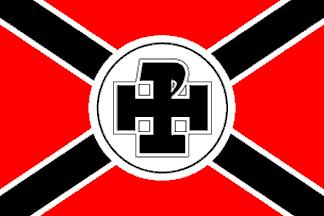
On the topic of symbols, here are some other things which I think should be avoided: anything with a swastika, a rune, lightning bolts, symbols set in white circles against a red backdrop (like the NSDAP flag); in other words, anything which looks like the symbols on the Anti-Defamation League's 'Symbols of Hate' web page. (See: http://www.adl.org/hate_symbols/default_graphics.asp ).

The European organisations, like the NDP and the FN, share advantages over the Australian: a large membership which enjoys a common sense of solidarity and belonging. Their ideas have a European flavour which are more in keeping with the followers of New Right Australia/New Zealand than other nationalist organisations, past and present. We can achieve the same results as the European nationalists, however, providing that we concentrate on forming a group, small at first, with discipline, unity and purpose and which has no pretensions to taking over Australia (and then the world) through victories at the ballot box.

Wednesday, January 10, 2007

ON NATIONALISM AND THE
SOCIAL QUESTION

by Rowan Patterson & Welf Herfurth*

The great Austrian political thinker and champion of free-market liberalism, F.A. von Hayek, made a famous distinction in his work between 'values' and 'merits', summed up in his famous slogan 'There is no value to society'. (Margaret Thatcher was attempting to convey the same idea when she made her famous assertion that 'There is no such thing as society'). Hayek argued that, when we assess the worth of a man's labours - in providing us with symphonies, or paintings, or glass etchings, or plumbing, or shoes, or whatever - the marketplace provides us with the only accurate assessment of their value. The market, which is made up of individual buyers and sellers, assesses the value of, say, a pair of shoes at $90. If buyers disagree with the price charged by the shoe seller, the latter must drop his price, and sell at a discount, if he wants to move his product off the shelves. If he refuses to budge on prices, or if he is underestimated the demand for his product (mistakenly believing that there is a large demand for his shoes, when there wasn't) he goes out of business.

But, says Hayek, suppose we take the socialist point of view and say that the shoe seller is a meritorious individual - that he deserves a 'better' price for his shoes than the one consumers are accustomed to paying, or that he deserves to have shoes sold in amounts large enough to make him wealthy. We are then assessing the shoe seller's labour on the basis of 'merit' and not 'value'. Hayek's point is that such an assessment is entirely subjective: the shoe seller and his friends and family may believe that he is meritorious, and deserves to make more money than he does; but the buyers in the market may have an entirely different valuation. The consequence of this is that it is impossible to get all parties to come to an agreement on 'merit'; but it is entirely possible to get all parties to come an agreement on 'value' - and such an agreement happens every day, in the market. Hayek believes that we cannot assess the 'value' of 'society' (or a something 'socially useful', 'socially beneficial') in that same impersonal (and clear-cut) way. Hence, 'there is no value to society'.

Hayek makes a similar distinction between an economy based on 'needs' and 'wants'. Joe Bloggs, an abattoir worker who lives in Cowra, needs a job in Cowra - otherwise he will be forced to move elsewhere to look for work, or take up a different career. In an economy based on 'needs', the government will ensure that Joe Bloggs is given that job. But suppose that there is not enough consumer demand for meat from Cowra: the abattoir will be forced to close down because of the impersonal pressure of the market. In an economy based on consumer 'wants', the government will allow the abattoir to close down and will do nothing for Joe Bloggs or the other abattoir workers.

Similarly, people in sparsely-populated rural areas may demand phone coverage from the national telephone companies, which are reluctant to service those areas because there will be no profit in doing so. In an economy based on 'wants', the rural population will have to go without phone coverage, or move to the city where they can obtain it; in an economy based on 'needs', the government will ensure that they are provided with phone coverage.

What relevance does this all have to nationalism? A great deal! Even the self proclaimed Neo-Nazi Bill White writes that
(at http://www.overthrow.com/lsn/news.asp?articleID=10057 ) that:

Even race, while fundamental to the National Socialist worldview is not central to the National Socialist argument. When I talk to my organizers -- and check out our mailing list on Yahoo groups if you want confirmation -- I don't tell them to talk about race first, or immigration first, or any of these other issues first when trying to communicate the advantages of National Socialism to white people. I tell them to talk about the economy first -- in all its aspects -- and from there to point at the Jews, and then to show how Jewish connection to racial issues, and social-cultural issues, and political issues "trickles down" and reveals their poison in every aspect.

As has been written here at the New Right Australia/New Zealand site many times, National Socialism and Italian Fascism enjoyed their success first and foremost because they were social and economic doctrines first, and everything else second. The question - 'Do we want an economy based on needs, or wants?' - is as relevant today for nationalists as it was in 1933 or 1922.

The mainstream Right believes that we should have an economy based on consumer wants; the mainstream Left, one based on 'human' and 'social' needs. It is held, by a good many media commentators and intellectuals, that the Right has won the debate on the global economy; the twentieth century was the century of socialism, but, in the end, communism imploded from within, unable to compete with the Western capitalist economies. Even the West had to adopt, after the crises of the 1970s, competition and deregulation - inevitable 'market reforms' - in order to survive and prosper. America and the UK do well, it is argued, because they adopted the 'reform' path; Germany, France and other Continental countries have stagnated because of their adherence to the old welfare-state socialism.

The purpose of this article is not to revisit that old and hackneyed debate: it has received enough attention from mainstream journalists and intellectuals in the past twenty-five years. The intention of this article is to look at the place of the 'needs versus wants' and the 'merit versus value' debate within the context of the nationalist political struggle.

Now, in 2007, we can look at the benefits, and drawbacks, of economic systems such as communism and fascism with more perspective than, for instance, the people living in the 1930s and 1940s. The general consensus, in the mainstream Western media, is that communism has failed - and it is a view I, like many other nationalists, share. Take, for example, Mao's China. The difference between Maoist Marxism and ordinary Marxism was that the former championed the peasant, the latter the blue-collar labourer: Maoism could be described accurately as Marxism for the peasant class - it sought, not a 'dictatorship of the proletariat', but a 'dictatorship of the peasants' (or, more accurately, a dictatorship of an elite group of intellectuals who would rule in the name of the peasants). That was the official Maoist party line (we know, however, that Mao cared little for the peasants, and was interested foremost in making China a great geopolitical force, capable of being a rival to both Russia and America). At any rate, Mao's economic policies were disastrous for Chinese peasantry: under the Great Leap Forward, for instance, millions of them starved to death, mainly thanks to economic bungling and neglect (which occurs too often under communism). No greater example of communist failure can be found: after all, communism, ostensibly, intends to improve the national standard of living, and one of the main arguments against capitalism is that it leads to poverty and misery. But communism - as we have seen from the example of China, North Korea, the Soviet Union, Cambodia and the African states which turned communist - led to even more poverty and misery than capitalism, and starvation on a hitherto unimagined scale.

Now, in the 2000s, China has been forced to adopt the market mechanism as an alternative to socialism; eventually it will move further and further from an economy geared towards satisfying 'needs' and to one which aims at satisfying 'wants'. Vietnam has done the same; only Cuba and North Korea remain as the last hold-outs.

Communism could have been expected to do well in Europe: after all, even the economically backward countries of Eastern Europe are far more developed than, for instance, China at the time of the communist revolution. Again, naive left-wingers in the West supported the Soviet Union in its war against Germany because they believed that the communist system was better: the fascists were tools of capitalism (so the party line went), and capitalism always leads to poverty, misery, injustice, inequality, etc. But, once the war was over, and the Red Army had conquered Germany and Eastern Europe, it turned out that communism as an economic system wasn't as good as capitalism or fascism; it was downright inferior. On a simple, day to day level, the standard of living was below that of the Western European countries: East Germany produced unreliable and inefficient state-designed cars, and built shoddy housing; and shoddy and inefficient consumer goods were the general rule throughout the whole Eastern bloc. No communist in the West would have been able to cope for long living in an Eastern bloc country, simply because of the vastly inferior standard of living. Communism in Eastern Europe, and the Soviet Union, declined for a number of reasons: but one of the main reasons is that, simply, the populations there wanted the lifestyle of the West: better cars, better clothes, better houses, reliable supplies of electricity, gas, and water...

For this reason, the communist parties in the West are, after the post-1989 collapse of Soviet communism, unpopular. That is, they do not have a mass base of support. Communist organisations may be active in student politics on university campuses; their refried Trotskyism manages to attract its share of followers (from my experience) of naive and politically uneducated youth. But it is out of the question that they will ever be able to win power in Australia or in any other Western country. The reason for that is that we all know, by now, that communism doesn't work. Or, rather, the price demanded by communism is too high for Westerners to pay; for one thing, our glitzy shopping malls will have to go (to replaced, presumably, by state-owned malls selling state-made jeans), and not even the most hardcore Leftist university student wants that. Communist activism in the West is one exercise in futility.

The reality is that, in Australia and most other Western countries, is that the Hayekian neoliberals have won for the most part. For the past 11 years, a conservative center-right government has actively striven to introduce competition. It has broken, for the most part, the trade unions' grip on the labour market, has allowed competition in various industries (including the dairy industry) and is now in the process of dismantling a price-support scheme for Australian farmers (which makes it illegal for farmers to sell their wheat overseas below a fixed price) which has existed for 67 years. It has also kept up the policy, introduced by successive Australian post-war governments, of free trade, and privatised the national telephone company.

The social democratic Labor Party, and members of the agrarian-socialist National Party (which, ironically, is in coalition with the conservatives), oppose these policies; many nationalists here in Australia oppose these policies as well. But my own reaction is: so what. The Labor Party, of course, opposes deregulation of the labour market because it is run by trade unionists who want to preserve their monopoly over the labour market. Competition in that area - where workers can work for less than minimum wage if they choose - will make the unions redundant. Likewise, the National Party is only looking after the interests of its constituency, Australian farmers - who believe (like farmers in France, America and Japan) that farming is a lifestyle, and not a business, and that the world owes them a living. The idea of putting agriculture on a market basis terrifies them, and rightfully so. Both groups - the blue-collar trade unionists, and the farmers - claim that their interests are the interests of Australia as a whole. But this is false. Non-white immigration does more damage to Australia than free trade or privatisation (in my opinion), but historically the unions and the farmers have done little to oppose it. A few trade unionists in Australia are now speaking out against immigration, simply because present government policies have loopholes which allow immigrants to work for below minimum wage. But, obviously, the concern of these unionists is based on self-interest, nothing more.

And if we are to judge the rightness or wrongness of every economic policy by self-interest, very well then: competition and privatisation does little to hurt me as a person. For example, competition in the airline industry in Australia, for instance, has allowed cut-price airlines like Jetstar and Virgin Blue to appear, which allow me to travel to nationalist conferences at cut-rate prices - something which would be impossible a few decades ago when established monopoly-protected airlines like Quantas dominated the market.

The problem is, I think, that many nationalists in Australia are prone to adopt the farmers' and the unions' struggles as their own; likewise, nationalists in other Western countries elsewhere do the same - champion the interests of farmers, or unions, or local business, against competition, from within or without.

They do so reflexively, because, they feel that, by being nationalist, they must side with the Left on nearly every economic issue. In my own experience, every nationalist I have encountered has opposed the neoliberal agenda of free trade, privatisation, deregulation, union-busting, etc. Nationalists take a left-wing position on most economic issues. This is for a number of reasons; but I think that the main cause is that the nationalism of Europe in the 1930s and 1940s was economically on the Left, and that that period of nationalism still has a great ideological influence on Western nationalists today.

And I agree: nationalism is, and should remain, Left when it comes to the economy. But groups like local manufacturers, unions and farmers are very strong already, and do not need the support of nationalists; furthermore, they will reject any overtures we will care to make towards them, either because they do not give a damn about the issues we care about - e.g., immigration, or freedom of speech - or because they do not want to offend Jews and liberals.

Besides which, by focusing on free trade, or privatisation, or competition, we are ignoring the real issues. For instance, we are not paying attention to the problem of the massive unemployment which exists in most Western countries. We in Australia have quite a severe unemployment problem - something which may come as a surprise to foreign readers, as the official rate is only 4.6%. But other statistics belie that figure. We have, in Australia, 2.6 million Australians on welfare. (See 'Putting the benefits in doubt', The Australian, December 30, 2006, at http://www.theaustralian.news.com.au/story/0,20867,20988424-28737,00.html ).
Of that 2.6 million, 700,000 are on the disability pension. (See: 'Labor on "backflip" on tests for the disabled', The Australian, December 28, 2006, at http://www.theaustralian.news.com.au/story/0,20867,20980454-2702,00.html ).
We also have an epidemic of single parents, most of them women, collecting single parents' pension: 423,000 as of September 2006. (See: 'Single mums back on the job', The Australian, January 8, 2007, at http://www.news.com.au/business/story/0,10166,21026129-462,00.html?from=public_rss ). Around 250,000 men in Australia between the ages of 25 and 44 are not looking for work. (See: 'Revealed: a nation of dropouts', The Age, April 17, 2006, at http://www.theage.com.au/news/national/revealed-a-nation-of-dropouts/2006/04/16/1145126008815.html).

So why is the unemployment rate only 4.6%? Firstly, because people are only counted as looking for work (and therefore being unemployed) if they are willing to take up a job in one week's time; secondly, anyone working at least two hours a week is counted as being employed full-time. These methods for counting the unemployed are set by the International Labor Organisation, an agency of the United Nations, and have been used in Australia since 1978. (Previously, the method used was to count the number of people on unemployment benefit. If that method were still in use today, the official unemployment rate would be 5.4%). Most other countries in the world use the method as well.

Understandably, that ILO method can downplay the number of unemployed quite dramatically. But hardly any mainstream political figure in Australia, whether on the Right or Left, questions its use; after all, the figures it produces are just too good. The conservative politicians, who have never been unemployed or experienced any significant economic hardship, simply assumes that the figures are correct and that the present conservative government has created a jobs cornucopia. (And indeed, deregulation of the labour market since the 1990s has created plenty of two hour a week jobs). So their welfare policy is fairly simple: the unemployed are scum, and deserve to be treated as such; the best policy is to use psychological pressure to force them off benefits and get them to look for work.

The policy has been successful insofar as that it has forced many people off unemployment benefits. It is safe to assume that many unemployed (or women, for instance, who would otherwise would have been unemployed) have jumped ship and become disabled, or single parents, simply because the requirements for those two pensions are less strict.

From my own experience (and the experience of anyone who is an urban commuter, or spends time in the central business districts of Australia's major cities), there is a growing, almost ubiquitous, Australian underclass. (The characteristics of an 'underclass' are, following the American author Charles Murray's definition, are: low rates of participation in the labour force, low educational attainment, a record of petty crime, chronic drug and alcohol abuse, poor diet, anti-social behaviour, and a penchant for giving birth to children out of wedlock). Comprising the underclass are a small, but growing percentage of the white population and a large percentage of the Indigenous population. Underclass people cannot find employment for two reasons: there are not enough low-wage, low-skill jobs for them, and employers find them too obnoxious and unprofessional to hire them anyway (at least at prevailing wage rates).

In Hitler's Germany, as we know, full employment prevailed. A small underclass existed (as it does in every society) which led a dissolute lifestyle and refused to work. The German government's policy was to offer a long-term unemployed person a job, and if that person refused a job offer three times in a row, they ended up in a concentration camp and wore a uniform with a black triangle - the symbol for 'asocial' prisoners.

In general, such a policy can be justified - in a situation of full employment. But Australia is not such a full-employment economy, even though the liberal democratic politicians say otherwise. The same can be said for other Western countries. (It is hard to judge the unemployment levels in other countries from a distance; but we can say for certain that unemployment in France and Germany is high, and that the same is true for most countries in Europe. Britain, which has low official unemployment figures, has a large number of people subsisting off the welfare state, as do the Scandinavian countries).

As to why we have a growing underclass, a number of complex social and economic explanations exist.

For one, most of the underclass traditionally would work in low-wage, low-skill jobs. But minimum wage laws effectively cancel out any such jobs. As well as that, most of the underclass are drop-outs from the working classes, who traditionally worked in low-skill manufacturing jobs, which are now being relocated offshore in Third World countries because of, among other things, minimum wage laws, high taxes and the simple fact that most workers in the Third World have a lower standard of living and therefore will demand lower wages than Australians.

Besides the economic, there are underlying social causes. The American author mentioned before, Charles Murray, believes that the decline of the institution of marriage is responsible for the growth of the underclass. Children in single-parent families grow up without a father who acts as a male role model. That is, the traditional husband and family man - who goes to work every day, stays monogamous, and does not engage in petty crime and anti-social behaviour - in the past acted as a role model and a stabilising influence. Nowadays, the welfare state, with its generous provision of single-parent pensions, pays women to bring up children without fathers. Furthermore, it encourages them to have more children in order to collect more money.

All of these explanations have value, I believe; even the work of a mainstream conservative like Murray has value in that it goes a long way to explaining the growth of the underclass, and what needs to be done about it. But it is essential for nationalists to recognise that nothing can be done about the underclass problem, and the unemployment problem, in a mainstream liberal democracy. Because of its inefficiencies, liberal democracy can do little to alleviate social and economic problems in the West - merely stave them off. (For instance, the German government has had 16 years to do something about Germany's unemployment problem, but has failed, and failed miserably, and will continue to fail).

But we have to draw a distinction here between the underclass and the rest: there are many people in Australia, and in the Western countries, who are down on their luck and who are not underclass scum. These people have been trampled on by successive liberal democratic governments. They have been left behind by both the mainstream Right and Left because, among other things, the unemployment statistics say they do not exist. (In Australia there is the spectacle of the person who is over fifty-five and who is without work. No employer will hire them because of their age, and, at the same time, they are too young to collect the old-age pension. There are also large numbers of over-educated university students who graduate every year and who are destined to dead-end and insecure casual work, or work as security guards, taxi drivers, etc. Also, a number of students who are still studying are forced to rely on charity thanks to, among other things, government cuts and the abolition of student services previously funded by the government).

It is my opinion that these people are potential recruits for nationalism - and good recruits at that. For one, they have some education and are (unlike the underclass) fundamentally decent people; secondly, they have the potential intelligence and perceptiveness to see that their problems will not be solved by a change in government at the ballot box. They will be receptive to the nationalist argument that the structural deficiencies in the economies of the West, and particularly the Western welfare-state countries like Australia, France and Germany, are due to the deficiencies inherent in liberal democracy.

So what are the solutions for the West's economic problems, in particular, its unemployment (and underemployment) problems? I am not arguing for complete and total socialism - as it exists in Cuba and North Korea - and I am not arguing for the complete cessation of 'free-market reform' either: only that there has to be a medium between the two. But the right direction lies towards the Left and not to the Right. We need to move towards an economy where people are treated on the basis of their 'merit', their 'social value', and not merely their market value. There are plenty of decent people who have been ground under by the economic mill, and who deserve better treatment.

In a previous article published -The radicalisation of the middle classes- (http://www.newrightausnz.org/articles/theradicalisationofthe.html) it was argued that nationalism should aim at forming its base in the middle class, following the example of the National Socialist and fascist movements of the 1920s and 1930s. That recommendation is correct: but it is essential to point out that the middle-class followers of Italian Fascism and National Socialism - the office workers, the small business owners, the intellectuals - were, for the most part, unemployed (or underemployed). They understood, instinctively, that the fascists were acting in their interest. Hitler never said anything as blunt as, 'Vote for me, German office girls, and I'll get you a job'; but that was the underlying message in the National Socialists speeches and writings. National Socialist and Italian Fascist propaganda was pitched at a fairly high intellectual level, aimed at Germans and Italians (and other Europeans) with a degree of education. That, combined with the repeated emphasis in that propaganda on 'social' needs and 'social' justice, meant that the lower middle-classes recognised fascism for what it was: socialism in their interest, and not that of the working-classes (who were either attracted to communism or mainstream social democracy).

Circumstances today, of course, are different than from Europe and the rest of the West in the 1930s. But they are similar in that the times are ripe for social revolution - a revolution of the decent, i.e., people who are not underclass but who deserve better treatment. The likes of a Hayek may object to such 'subjective' assessments of value. But governments are always allocating resources on the basis of some perceived merit, and this is a fact of life. In Australia, for instance, immigrants from Sudan get preferential treatment; waves of Africans are brought over, either to work in low-wage, low-skill jobs, or, more likely, put on welfare with that last wave of 'refugees' we all had to feel sorry for - the Vietnamese. Whatever contribution the African, Vietnamese and Muslim immigrants make to economic life (and it is minimal, in my opinion) is overshadowed by the social cost. (But, to Hayek, we cannot assess 'social' cost).

Nationalists will have, in my view, little to no serious competition when it comes to tackling the 'social question'. The Marxists, surprisingly enough, are out of touch on social issues. In the main, this is because of their narrow-minded ideology. In their worldview, there only 'good' working-class people and 'bad' corporations (with the petit bourgeoisie existing in the middle). The Marxist fights for social justice for the working-class, but ignores the plight of the middle-class. Furthermore, the analysis of the Marxists is limited: social problems are caused by capitalism and the big corporations; the idea that Jews, for instance, could be a contributing factor to social decadence and decline is nonsense - anti-Semitism is 'the socialism of fools'. The Marxists further alienate themselves from ordinary people of Indo-European descent when they champion the rights of immigrants, and denounce any opposition to immigration as racism, fascism, etc.

As we all know, the economic depression of the 1930s brought the German National Socialists to power. Many Westerners believed that fascism was a viable alternative to liberal democracy, which, it was perceived, had failed. It is for that reason that more than a few nationalists today express a desire for some economic catastrophe, comparable on a scale to that of the 1930s, to occur. After all, that will only increase support for nationalism. (We know that, electorally, the German National Socialists did badly in the late 1920s because, among other things, of the improving economy). But I believe that this argument is fallacious. For one thing, the catastrophe, in many Western countries, is already here. Germany today, for instance, has more people on its unemployment rolls than during the Depression.

In order to attract more public support, nationalists need to bring up, again and again, the 'social question' - and persuade people that the causes of any economic deprivation go deeper than the mainstream analysis. (That is, we know that the economies of the West may be bad because of high inflation, high interest rates, high taxes; but why the high interest rates, why the high taxes? Why do we have a class of politicians who embark on policies which we all know will only hurt the economy?).

At the same time, we must not make the mistake of leaping straight into electoral politics, expecting that, once we form a new, populist party, nationalists will come to power and make everything right again. Pauline Hanson's One Nation did a good job, initially, of addressing the 'social question' and the concerns of people who had been left behind by the policies of the mainstream parties; but it failed to build up a critical mass of popular support as preparation for any electoral activity. At the federal elections of 1998, One Nation received one million votes, but failed to break through Australia's proportional voting system; the major parties triumphed.

Nationalism must, before it becomes embodied in a party, be a state of mind and a mass movement; a state of mind and a movement which exists in a large segment of the population - the 'decent' we have identified here.

*Welf Herfurth is a political activist who lives in Sydney / Australia. He was born and raised in Germany. He can be contacted on herfurth@iinet.net.au

Tuesday, December 12, 2006

Nationalist Socialism, Nationalist Communism and National Bolshevism

by Andrew Webb


I've written this essay on the demand of the owner of this site, in order to make clear some vital distinctions between three ideologies: national socialism, national communism and National Bolshevism. (A note: when I refer to 'the movement' in this essay, I am referring to the large number of anti-'Semitic' and racialist groupings traditionally associated with the Far Right, in North America, Europe and European colonies such as South Africa and New Zealand).

NATIONAL BOLSHEVISM

What is National Bolshevism?

To answer this, we must look at the development of the socialist idea.

It was generally agreed, in the patriotic and anti-Semitic circles in Europe at the time, that the Russian Revolution of 1917 (and the aborted revolutions in Hungary in 1919 and Germany in 1918) were Jewish affairs. Jews had been fomenting subversion against the absolute monarchist regimés of Europe since the days of the Enlightenment and the French Revolution, and had appropriated the socialist idea for use as a means of gaining power. This subversion culminated in the Russian Revolution.

The Slavic racial element played a role, of course. Contemporaries of the revolution such as Hitler, Spengler and Lothrop Stoddard noted that Russia, since Peter the Great, had been divided into two: on one side, the Westernised Petrine aristocracy, mostly of German stock; on the other, the Asiatic residue possessed of a deep, primitive religiousness and a hostility to anything Western. The Revolution saw an uprising among the Asiatic racial element against the Westernised aristocracy.

What the Jews did was harness the Asiatic maelstrom and used it as a stepping-stone to power. Jewish Bolshevists exterminated the Petrine ruling class, and killed and starved millions of Russian supporters of the old regimé, in particular the peasants (who, as a class, have always been despised by Jews everywhere).

When does the 'national' in National Bolshevism enter the picture?

With Stalin's ascent to power to in 1924, Trotsky's exile in 1928, and the purges of the communist party rank and file (which, as we know, mostly consisted of Jews) in the 1930s, some anti-Semites claimed at the time that this saw the end of Jewish influence in the Soviet Union. Therefore, Hitler and other fascists were mistaken in detecting a Jewish component in Stalinism. This doctrine is one version of National Bolshevism.

As well as this, Stalin was condemned by the (Jewish) Trotskyists, for restricting socialism to 'one country', for not fomenting subversion elsewhere. Stalin had made socialism too nationalistic - a 'national socialism', in fact -when socialism, at bottom, is incompatible with nationalism. Stalinist 'national socialism' of this kind is often called National Bolshevism as well.
(Wartime Russian propaganda never referred to the Nazis as 'national socialists': that was the term used by the Stalinists to describe their own communism. The communists testifying at the International Military Tribunal always referred to the Nazis and the Wehrmacht as 'Hitlerians' or 'fascists').

In Weimar Germany, some communists, such as the Jew Karl Radek, advocated an alliance between Germany and Communist Russia, as early as 1919. It was felt that were Germany to take such a course, it would be resisting the West, which had imposed the Versailles Treaty upon it. In other words, Germany would turn Bolshevist out of nationalist and geopolitical reasons. That idea survived into the 1930s and could be found in the left-currents of German National Socialism, as represented by Goebbels, the Strasser Brothers, and Ernst Röhm and his communist Brownshirt faction.

So far, we have identified three National Bolshevisms: one, anti-Semitic, pre-war Stalinism; two, nationalist communism (or what I call national communism); and three, the advocacy of an alliance between Germany and a Bolshevism which may or may not be Jewish.

THE MYTH OF PRE-WAR ANTI-SEMITIC STALINISM

Did an anti-Semitic Stalinism of the 1930s exist?

In my opinion, no: the notion that Jews had been purged by Stalin in the 1930s is a falsehood. This is proved by the Holocaust Revisionist Walter N. Sanning's The Dissolution of Eastern European Jewry (1983), a study of Jewish demography in Europe and the Soviet Union before and after the "Holocaust".

Sanning's figures showed that from 1926 to 1939, the Jewish population in the Soviet Union increased from 2.6 million to 3 million - a jump of over 12%. Furthermore, the Jewish population of Leningrad increased from 84,000 in 1926 to 200,000 in 1940 and the Jewish population of Moscow increased from 131,000 to 400,000 in the same years.

As for the war, 200,000 Jews died as servicemen in the Red Army and 130,000 Jewish civilians died in the Nazi-occupied areas of the Soviet Union. An unknown but high percentage of the latter were killed as partisans, or in retaliation for partisan atrocities; others were killed by the Soviet natives for their role in the slaughter and deportation of tens of thousands of Slavs.
Added to this, there is plenty of anecdotal evidence concerning Jewish commissars, Jewish partisans, Jewish collaborators with Soviet occupiers, and so on. Jewish communists, and Jews in general, supported the Soviet Union's war against fascism, and certainly the very Jewish Roosevelt administration did.

THE DEJUDAISATION OF BOLSHEVISM?

Nevertheless, the Soviet Union stopped, at some point, being Jewish. Historians of international relations would agree that the Soviet Union had become an enemy of America (and hence Jewry) sometime around 1948. Stalin, of course, armed Israel in its "war of independence" against the Arabs in 1948, funnelling arms through Czechoslovakia, and the USSR was one of the first States to recognise Israel diplomatically. But 1948 also saw the breakdown of amicable relations between America and the USSR. And by 1953, the year of the 'doctor's plot' and Stalin's aborted plan to exterminate Soviet Jewry, the love affair between the Jews and Soviet communism was over.

The question is: why did the Jews fall out with Stalin? The answer, I think, is to be found in Sanning's statistics.

The USSR incorporated 2 million Jews in 1940 (with the annexation of Eastern Poland, the Baltic States and North-Eastern Romania), raising its Jewish population from 3 to 5 million. But it lost 1 million Jews in the war, many of those in senior positions in the communist hierarchy. The majority of those fatalities - 700,000 - had died in labour camps in the Siberia and the Urals alongside millions of other Soviet citizens.

Stalin had been prepared years in advance for a European assault on the USSR. Before and during the Nazi attack, he deported millions of Soviet citizens (Sanning gives the figure of 25 to 30 million) away from the front line and to Siberia and the Urals. There they were put to work manufacturing arms and electricity.

The production of arms and electricity required skilled personnel. Jews occupied the leading administrative positions in the Soviet Union and formed the most educated class, standing at the top of the social pyramid in the Soviet Union, just as they do in America now. Stalin deported them for this reason. (A large number of women and their children were deported because many women were employed in Soviet industry, thanks to feminist reforms).

Sanning estimates that of the 3.6 million Soviet Jews living in areas which later came under Nazi control, 80%, or 2.9 million, were evacuated. Five million people alone from the Ukraine were deported, a high proportion of whom were Jews or ethnic Russians (both of whom occupied the leading professional and administrative positions in Ukraine, to the detriment of Ukrainians).
Because of the losses in the labour camps, and in combat with European armies, the élite Soviet Jewish class was gutted. Although a large number of Jews remained in the Soviet Union - over 4 million - the power of the Jews there had been broken.

(For more on the implications of Sanning's work, see Yggdrasil's essay Princeton Tries to Explain a Drop in Jewish Enrollment; or "What is Communism?")

This is why neo-fascists who were more sensitive to geopolitical developments, such as Francis Parker Yockey and Jean-Francois Thiriart, proposed an alliance between post-war fascism and Soviet communism. They believed that were the Russians to win the Cold War and overrun Europe, Europe would be dejudaised as well. Therefore, an opening could exist to mobilise the Continent for a war against America (and Israel).

NATIONAL COMMUNISM

After the war, and the breakup of the European empire, a new phenomenon emerged: national communism, or more accurately, national liberation communism.

Yockey held that ever since the First World War, the 'Outer World' (the non-European colonial world) had been agitating against the colonial powers Europe and America. He called the desire of the coloured races to overthrow the white man 'Bolshevism' (although of course, the anti-colonialist tendencies were not restricted to the communism of the USSR).

It was Europe's defeat at the hands of America in WWII, Yockey argued, that saw the downfall of the European colonial empire - the largest in history. 'Bolshevism' stood triumphant. Although America, by winning the war against Europe, inherited Europe's empire, it showed no interest in maintaining it, giving the most valuable possessions away (China and India in particular).

Many of the 'Outer World' countries did not win their independence at once, having to overthrow colonial rulers like Britain and France by force. The national revolutionaries adopted communism as an anti-colonialist ideology, as communism is uniquely suited to that purpose. But they gave it a different slant from orthodox Soviet Marxist-Leninism, a more 'national' flavour. Hence Maoism, Castroism, Ho Chi Minhism and the rest.

This independence from Soviet communism, however, was only ideological. After achieving independence, a country like Vietnam or Cuba would have no option but to join forces with one of the two communist superpowers, China and Russia.

NATIONAL SOCIALISM

By 'National Socialism', I am not referring to the German variety, of course, but a post-war variant of national communism. More or less, other anti-colonialist tendencies in the 'Outer World' did not want to go the whole route towards communism, opting instead for 'socialism', which would see the retention of some private property.

In addition, they differed from the national communists in that they followed the policy of non-alignment. This refers to the practice of neutrality in the Cold War: non-aligned countries went with neither the East nor West, choosing instead a 'Third Position'.

The most famous exponents of the 'Third Way' were Juan Peron (Argentina), Nassar (Egypt), Sukarno (Indonesia), and a host of other Third World demagogues. Yockey writes, in his essay The World in Flames (1961):

No estimate would be complete which leaves two great political developments out of account, both of recent years. The first is the Arab Revolt, led by a great and vigorous man, Gamal Abdul Nasser. The second is the formation of nationalist, neutralist regimes by such brilliant statesmen as Marshal Jozef Broz Tito of Yugoslavia, Nehru of India, Field Marshal Ayub Khan of Pakistan, General Ibrahim Abboud of the Sudan, Sekou Toure of Guinea, Sukarno of Indonesia, Nkruniah of Ghana, and others. These personalities embody an Idea, none are out for money or publicity. They live simply, work for and live for their ideas. One such man, in a position of leadership, is a world-historical force. All lead weak political units, and cannot by themselves fight either of the great world-powers. But all want independence for their people; Nasser, for example, for some 300,000,000 Moslems. Each is a symbol to great human masses. Their significance, in each case, in this Estimate, is that they diminish the Jewish-American power without augmenting the Russian-Chinese power. By their Palestine policy, the Zionists may even succeed in driving the Arab world to fight for Russia. Eventually responsible leadership for a restive mass of some 180,000,000 Latin Americans will evolve. Already the seeds of revolt against Jewish-American economic domination have been sown. Witness Cuba.

Nowadays, the surviving national socialist regimes include Libya, Iraq, Syria, and Burma. The Burmese junta are the authors of a manifesto called 'The Burmese Path to Socialism;' Iraq and Syria both subscribe to the Arab nationalist and socialist ideology of Ba'athism.

The national socialist regimés mentioned by Yockey have either crossed over into the American sphere of influence or have become irrelevant. Indonesia, India, Pakistan and Egypt now serve as vassals to the West; the African nations have become insignificant - which is another way of saying that they are so strife-torn that no superpower can be bothered gaining a foothold there. (I am speaking of the black African states, of course, not the Arab ones in North Africa: Libya, Tunisia, Morocco and Algeria, because of their proximity to Israel, occupy important places on the geopolitical chessboard). For the most part, the West has regained control over all its errant colonies - except that the Jews of Washington and Tel Aviv, and not Europeans and Americans, now rule 'the West'.

JEWISH ANTI-COMMUNISM

Up to 1948, we could say that all Jews were united in support of two causes: 'Bolshevism', as defined by Yockey, and the destruction of fascism and monarchism in Europe. Jews, in America and elsewhere, were Stalinist communists or liberal supporters of communism.

Then, after 1948, Jewish-controlled America became the biggest enemy of communism. All at once, we saw: former Jewish communists, such as Sydney Hook and Irving Kristol, leading an ideological assault on communism and founding the neoconservative movement; the Red Scare; the coming to American consciousness of the extent of Stalin's cruelty; accusations that the USSR was 'anti-Semitic'; and so on. Why?

Yockey's answer was as follows: in 1917, the Jews gained control of the Soviet Union; in 1933, the Jews gained control of America upon the election of Roosevelt; in 1945, the Jews, through the USA, controlled Europe and the entire colonial world; but by 1948 or thereabouts, the Jews had lost control of the Soviet Union, for the reasons described above.

At the end of the war, the Jews, possessed a vast European colonial empire; but, with the onset of the Cold War, they had to fight the colonial subjects who wanted 'Third Positionism' or an alliance with the Soviet Union.

But Jews are inherent Bolshevists, motivated by one desire: to destroy European-Western civilisation. Their quarrel is not with the peoples of the coloured races, but Westerners. They do not hate Russia with the same intensity that they hate the Germans.

As Yockey writes, in The World-:

Most of the cinema in North America treats Russia and Russians as interesting and admirable, human and good. The cinema's purpose in the general scheme of propaganda is to control the emotional attitudes of the population. Control of the intellectual attitudes is the work of the press, and here Russia is treated negatively. Why this duality? Every ruling regime gives perforce in its propaganda a picture of itself, and the Washington Zionist regime itself suffers from this quality. Russia is not a total enemy, but a rival. The Korean war, 1950-1953 expressed the limited hostility of the Washington regime toward Russia and its official war-aim was not "victory" or "unconditional surrender" [as per against Nazi Germany], but "a just truce". When the Germans in Russia make some new technical advance, Eisenhower congratulates the Moscow regime. Roosevelt never congratulated Hitler on such occasions. The Russian flag is flown in the United States on all festive, "international" occasions. Never did the German flag appear, nor does it today. The fundamental ineradicable Jewish hatred of Germany appears in the fact that even the Germany they control directly is not permitted to sit among the United Nations, on a par with the other puppets. The spate of anti-German films in the theatres and on television continues unabated. The anti-Russian films are few indeed. One conclusion emerges, of military-political significance: in the Third World War, the Washington regime will list Germany among its enemies. Already the radio propagandists say "Russia and Red Germany." The intention here is, not only that the German rifle battalions be slaughtered by the Russian advance, but that the way be opened for the bombardment of Germany again, this time with more destructive bombs.

To a certain extent, Jewry considered communist Russia and China to be friendly rivals, not deadly enemies, like Nazi Germany, which had to be destroyed at all costs. And, certainly, Jewry sympathised with the Bolshevist aims of the Russians and Chinese- eg, the goal of the liberation of the Third World from European and white domination.

THE FACTIONAL SPLIT IN JEWRY

One of the most common objections to anti-Semitism is that anti-Semites lump all Jews together, making them out to be a monolithic conspiracy, when clearly Jews disagree on a good many questions - Israel for instance.

Most rational non-Jews, who are not completely deluded by philo-Semitic and Zionist propaganda, will agree that Israel and its supporters in Diaspora Jewry are a vicious bunch. But, say the incorrigible philo-Semites, 'Not all Jews support Israel. Why, my friend Greenburg hates Israel, and he's a Jew'.

The fact that Bush Jr (like every American president before him) is a slave of Israel, and that his foreign policy is written for him by hard-right Zionist Jews like Richard Perle, is an open secret. But we all know, too, that Jews such as Noam Chomsky, Israel Shamir, Israel Shahak, Norman Finklestein and even mainstream Jewish reporters such as Suzanne Goldenberg (of the British newspaper The Guardian) and Orla Guerin (of the BBC) number among the biggest boosters of the Palestinian cause.

The dichotomy is explained by the fact that Jewry now is in the possession of the mightiest military and political power in history - the United States - and all the vassal states which the US has conquered through force or diplomacy. As the ruling élite of the Jewish-American State, it is under an obligation to maintain the empire if it does not wish to surrender it. At the same time, it feels sympathy for the 'Third World', even for the Palestinians in their national liberation struggle against Israel.

Jewry is divided into two factions: on the left, we find the liberal Zionist or anti-Zionist Jews who feel that the Arabs are their natural allies in the struggle against European civilisation; on the right, the neoconservative hawks - a tendency represented now by Richard Perle and Paul Wolfowitz - who want to use goyim armies to annihilate the enemies of Israel.

Yockey, describing the factional split in Jewry, writes in The World- that:

It is a psychological riddle, decipherable only thus: the Zionists have two minds, which function independently. As Zionists, they are committed to the destruction of the Western Civilization, and in this they sympathize with Russia, with China, with Japan, with the Arabs, and as such they anathematize Germany, which is the mind and heart of the Western Civilization. As custodians of the United States, they must half-heartedly remain at least the technical and political domination of that Civilization even while destroying its soul and its meaning. In a word, they are working simultaneously for and against the Western Civilization. Quite obviously they are thus doing more damage than conferring benefit! If a commander of a fortress sympathizes with the enemy, but yet insists in defending the fortress rather than surrendering it, he has surely found the highest formula of destruction.

GOOD JEW, BAD JEW

William Pierce, in a radio talk, once spoke of the factional divisions in the (2002) coalition government in Israel: on one side, Shimon Peres, the leader of the Labour Party, the "dove"; on the other, Ariel Sharon, the leader of the Likud, the "hawk". Peres and Sharon, Pierce said, were 'good cop and bad cop', or at least hoped to present themselves as so to the goyim of the West.

Clearly one could not find two Jews more dissimilar than, for instance, radical leftist Noam Chomsky and extreme Likudnik Richard Perle - but are they that dissimilar?

Both the Zionists and anti-Zionists only differ in the field of foreign policy. The Zionist Right in America generally agrees with the social program of the anti-Zionist Left. That is, both favour: more forced immigration of non-whites; more multiculturalism; more MTV; more pornography; more cultural nihilism; more permissiveness towards Negro and Hispanic crime; more attacks on the cultural heritage of Europeans and Americans; and so on. Certainly neither Jewish faction can abide any Nazism, fascism, anti-Semitism or "racism" of any sort (although the neoconservative Right is sympathetic to anti-Muslim "racism"). Holocaust Revisionism is definitely out.

The truth of the matter Jewish-American "liberals" and "conservatives" are working towards the same Jewish-Bolshevist goals: they only disagree on how these are to be implemented.
The neoconservatives believe that 'democracy' and 'free markets' will do the trick and should be imposed upon recalcitrant Muslim nations, by force if necessary. The radical Jewish-American left, on the other hand, focuses on domestic policy: it wants to eliminate 'capitalism'.

That 'capitalism' is not, of course, Jewish capitalism (Jews are the wealthiest economic group in America), but the capitalism of the Rockefellers and Fords and other Yankee, WASP, East Coast plutocrats - the kind who ruled America before the ascent to power of Roosevelt and his gang of Jewish liberals and crypto-communists.

The America before 1933, as Pierce wrote, was, for all its faults, healthy and white, and for this reason the American Jews of both the Right and Left hate it and want to extirpate it. The neoconservatives may not be as obsessed with destroying European culture and civilisation from within as the liberal and anti-Zionist Jews are, but this is because they give the political destruction of enemies of Israel more priority than anything else.

Even so, the neoconservatives are not completely indifferent to domestic politics. They will use the opportunity of a civil state of emergency, like the present one that exists in America, to crack down on white nationalists, anti-Semites, Holocaust Deniers, and so on.

OPPORTUNITIES & STRATEGIES

The Bush administration, since 9-11, has been a godsend for anti-Semites: America, as a power, has become completely Israelised; it emanates the obnoxiousness, the self-centredness, the solipsism and the bullying arrogance of the Jew. As a result, it has alienated the Muslim world and not a few independent-thinking Europeans, of all political persuasions, as well. (At this rate, we can only hope that Bush and his neoconservative coterie win re-election in 2004).

It is possible that Jewry will win its war against the Muslim enemies of Israel: after all, it won the war against Nazi Germany, and against post-Stalinist Russia - both of whom were tougher opponents than the Arabs. But the world has become tired of Jews. One can say that Jewry has long been the chairman of the board of the 'Bolshevist' corporation, but now the shareholders - the coloured peoples of the Third World countries the USA rules or seeks to rule - are becoming disgruntled. Perhaps the coloured peoples will look for, and find, a new leader in the person of Russia or China.

What of the peoples of European descent? Should they join forces, like the National Bolshevists of old, with the Third World enemies of Jewry - ie, China, Russia and the 'rogue states'?

Obviously, the National Bolshevism of Yockey, Thiriart, Otto Remer ended in failure: by the 1980s, it was apparent to all that any alliance between European nationalists and the USSR would fail to deliver the goods. The world economy had been torn apart in the 1970s, and the USSR's brand of socialism - unlike China's - was incapable of weathering the storm. The USSR, then, was placed in a position of extreme weakness, with the results we all know. We in the movement sided with a loser; it is possible that, by siding with the Arabs, we are siding with another loser, and that the Arabs will be defeated just as the Russians were.

One of the problems with Arab nationalism and Islamic fundamentalism is that neither of them possesses a true antagonism towards the Jews and Israel. The truth is that Judaism is part and parcel of the Arabic-Middle Eastern culture, history and civilisation. At bottom, the quarrel between the Arabs and the Jews is nothing more than a brother's quarrel - like, for instance, a quarrel between French and Germans. The Muslims really only make two demands on America and Israel: that Israel withdraw from the Occupied Territories, evacuate the settlements, and allow the formation of a Palestinian State; and that Israel withdraw from the Golan Heights.

Were Israel to do so, it would guarantee peace with the Palestinians and with Syria, and the entire Muslim world, and we in the West would lose an ally in the Arabs.

On the other hand, we in the West who are aware of the Jews' true character have grievances against the Jew too numerous to mention. At bottom is our visceral disgust for the Jew: we do not see him as a wayward brother, as the Muslims do, but a total enemy who is completely foreign to us and who is responsible for the most terrible crimes in history. We will not be satisfied by a mere Israeli withdrawal from the Territories and the Golan - what good would that do us?

Eventually, we in the West will need to wage war against the Jew - a total, no-holds barred, war. The Arabs and the rest of the coloured world will have no stomach for that: their opposition to the Jew is merely political, not racial, cultural, spiritual.

Furthermore, the Arabs and the rest of the Third World will oppose the revival of an America and a Europe under a white, as opposed to Jewish, leadership. The three superpowers today are China, Russia and Israel-America. The coloured races have no real objection to this arrangement: they much prefer that America and Europe be ruled by Jews than by whites, for Jews are fellow members of the 'Bolshevist' club, and victims, like them, of Western "racism" and oppression.

Suppose that the Negroes of America were given a choice between the present Jewish-controlled politicians - who at least can be counted upon to give them plenty of welfare - and a government of white separatists: who would they choose? The question answers itself.
FNF NOTE: At this point I must object. Why should they have to choose between either? Why not give them a government and a community/land of their own which they and they alone are responsible for its success or failure?

It is true that Westerners who want to overthrow Jewish rule are in a vulnerable position, that we need all the help we can get - and that means help from the Russians, Chinese and the Arabs. American nationalists should not even spurn offers of assistance from disaffected Negroes and Hispanics.

THE VERDICT ON NATIONAL SOCIALISM

Whether or not one adopts a National Bolshevist stance - and by that I mean a stance of anti-Semitic socialism - depends on one's economic views. Some in the movement see capitalism as a degrading, exploitative, unstable economic system which must be replaced with socialism at all costs; others have no problem with it. Clearly, socialism, at the present, is further away from realisation in the Western world more than ever. Despite the recurring financial and economic crises which have occurred since 1970, capitalism still endures. I would venture to say that, at this point in time, socialism - or even corporatism, which has been championed by many distinguished theorists of post-war fascism - is an unrealistic option.

At any rate, we in the movement should strive for product differentiation: that is, offering prospective recruits something they will not find in, for instance, the ideologies of anarchism/Marxism, environmentalism, conservatism, and so on. Our strength lies in our willingness to address racial politics, and, above all, our willingness to name the Jew.

Certainly anti-Semitism is compatible with a wide variety of ideologies: there is no reason why the Green parties around the world should not stand on anti-Semitic, anti-Israel platforms and espouse Holocaust denial. Likewise, there is no reason why a 'pink' liberal cannot be racialist: after all, the Democrat Party in America was the bastion of Southern racialism for many years.
But it just so happens that only our movement is left to take up cudgels on the race question and the Jew question. The Jews and their vassals have seized control of all the disparate political factions of the West - on both the Left and Right - and succeeded in removing any "racist" and anti-Semitic ideological elements. The movement, on the other hand, has been left alone. Part of this is because our movement, in the post-war years, has been too small and unimportant for the Jews to infiltrate and take over; but mostly it is because we have deliberately fostered an environment in which no Jew could ever feel welcome.

As a result, we in the movement have the monopoly on racialism and anti-Semitism, and, in these present times, when the Jewish domination of American and European policy is becoming clear to even the most imperceptive individuals, we should be exploiting that monopoly as much as possible. That means, then, putting our doctrines on economics and social policy on the back burner for the time being. The movement, at the present, is incapable of steering the Western world towards socialism: but it can foment anti-Semitism, which will do more to destabilise the Jewish (and Masonic?) political and financial power structure more than any socialist polemics.


Russian National Unity and National Bolshevik Flags provided courtesy of FOTW. For further information on the flags of the rising 'Red and Brown Axis,' visit:NAT. BOLSH. FLAGS

FNF NOTE: The author's conclusion that for now, we must place all other Social Justice issues and environmental concerns aside are entirely disagreed with. Our greatest strength is that we are not just simple minded racists like the majority of the "movement" he speaks of. Our strengths are given to us by the fact that we are concerned with a plethora of issues, folkish autonomy is but one of the many issues we are taking heed to. Those that only concentrate one the one issue, we believe, are doomed to failure. The so-called "movement" that is referred to throughout the article has only that one cause. It is for that reason that their "movement" is stagnant and hasn't moved anywhere for decades. The very thought of giving space on one of their websites to causes like National Bolshevism, National Anarchism, and Third Position movements would send most of these pathetic right-wing reactionaries into anaphylactic shock! Instead, we must move forward, not left or right, and continue in the fight for National Freedom, as well as Social Justice!

Taken from http://www.folkandfaith.com/articles/nationalbolshevism.shtml